
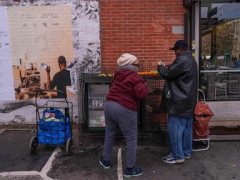

When major disruptions happen in communities, often the first people to respond are the residents themselves and their neighbors. When the pandemic shut down daily life or after a disaster like a hurricane or wildfire, people get together to take care of each other.
Even outside of a crisis, some who struggle to meet their needs may turn to mutual aid, the practice of finding resources from within a community and exchanging them for free.
Now, in response to government funding cuts, high prices and political uncertainty, especially targeting immigrants, interest in mutual aid projects has picked up, organizers and participants say.
“The exciting part about mutual aid is that you can really get together and help people in a really meaningful way just by pooling resources and being willing to reach out,” said Mary Zerkel, who lives in the Rogers Park neighborhood in Chicago.
Mutual aid practices have a long history, especially among immigrant and Black communities in the U.S., like the Black Panther’s Survival Programs or informal pooled savings circles.
Examples include sharing food, exchanging household goods and clothes or organizing shared items like tools. In recent years, groups have helped people access reproductive healthcare, including abortions, and coordinated collective responses to immigration arrests under the umbrella of providing mutual aid.
In 2019, Zerkel helped start a shared artist and community space in her neighborhood along with a local chapter of Food Not Bombs, a longstanding mutual aid group that distributes food. When the pandemic hit, they cleared out the art supplies.
“All of a sudden, we had six fridges in there and we were feeding and delivering meals to 400 families,” Zerkel said.
Over time, the organizers adapted to changing needs. When they realized people needed items beyond food, they started a “free store,” where people can donate things they don’t need. They trained volunteers in de-escalation techniques to diminish the possibility of ever calling the police. Later, they sourced naloxone, which reverses opioid overdoses, and held trainings on how to use it.
“The main thing is that you’re not trying to be an institution,” Zerkel said. “You’re trying to be a neighbor helping a neighbor, so you can do the best that you can and try to be responsible and loving to your neighbors and build something slowly.”
Many mutual aid networks are not incorporated as formal organizations or nonprofits. Giving to them won’t offer a tax deduction, but organizers say that b