
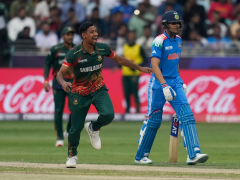

New Delhi, India – On January 3, 2026, a single directive from the Board of Control for Cricket in India (BCCI) quietly ended the Indian Premier League (IPL) season of Bangladesh’s only cricketer in the tournament, Mustafizur Rahman, before it could even begin.
The Kolkata Knight Riders (KKR), a professional Twenty20 franchise based in Kolkata that competes in the IPL and is owned by Red Chillies Entertainment, associated with Bollywood actor Shah Rukh Khan, were instructed by India’s cricket board to release the Bangladesh fast bowler.
Recommended Stories
list of 4 items
- list 1 of 4‘I didn’t set out to break records’: Pakistan’s first female MMA fighter
- list 2 of 4Kevin Durant passes Wilt Chamberlain on all-time NBA scoring list
- list 3 of 4Nigeria coach steers clear of Osimhen fallout and unpaid bonus rumours
- list 4 of 4Algeria vs Nigeria: A clash of AFCON’s tightest defence and its top scorers
end of list
Not because of injury, form, or contract disputes, but due to “developments all around” – an apparent reference to soaring tensions between India and Bangladesh that have been high since ousted former Bangladesh Prime Minister Sheikh Hasina received exile in New Delhi in August 2024.
Within days, Mustafizur signed up for the Pakistan Super League (PSL), the Bangladesh Cricket Board (BCB) protested sharply, the IPL broadcast was banned in Bangladesh, and the International Cricket Council (ICC) – the body that governs the sport globally – was pulled into a diplomatic standoff.
What should have been a routine player transaction instead became a symbol of how cricket in South Asia has shifted from a tool of diplomacy to an instrument of political pressure.
Cricket has long been the subcontinent’s soft-power language, a shared obsession that survived wars, border closures, and diplomatic freezes. Today, that language is being rewritten, say observers and analysts.
India, the financial and political centre of world cricket, is increasingly using its dominance of the sport to signal, punish, and coerce its neighbours, particularly Pakistan and Bangladesh, they say.
The Mustafizur affair: When politics entered the dressing room
Rahman was signed by KKR for 9.2 million Indian rupees ($1m) before the IPL 2026 season.
Yet the BCCI instructed the franchise to release him, citing vague external developments widely understood to be linked to political tensions between India and Bangladesh.
The consequences were immediate.
Mustafizur, unlikely to receive compensation because the termination was not injury-related, accepted an offer from the PSL – picking the Pakistani league after an Indian snub – returning to the tournament after eight years.
The PSL confirmed his participation before its January 21 draft. The BCB, meanwhile, called the BCCI’s intervention “discriminatory and insulting”.
Dhaka escalated the matter beyond cricket, asking the ICC to move Bangladesh’s matches from the upcoming T20 World Cup, which India is primarily hosting, to Sri Lanka over security concerns.
The Bangladeshi government went further, banning the broadcast of the IPL nationwide, a rare step that underlined how deeply cricket intersects with politics and public sentiment in South Asia.
The BCB on January 7 said the International Cricket Council (ICC) has assured it of Bangladesh’s full and uninterrupted participation in the ICC Men’s T20 World Cup 2026, dismissing media reports of any ultimatum.
The BCB said the ICC responded to its concerns over the safety and security of the national team in India, including a request to relocate matches, and reaffirmed its commitment to safeguarding Bangladesh’s participation while expressing willingness to work closely with the Board during detailed security planning.
Yet for now, Bangladesh’s matches remain scheduled for the Indian megacities of Kolkata and Mumbai from February 7, 2026, even as tensions simmer.
Navneet Rana, a BJP leader said that no Bangladeshi cricketer or celebrity should be “entertained in India” while Hindus and minorities are being targeted in Bangladesh.
Meanwhile, Indian Congress leader Shashi Tharoor questioned the decision to release Mustafizur Rahman, warning against politicising sport and punishing individual players for developments in another country.
A pattern, not an exception
The Mustafizur controversy fits into a broader trajectory.
While all cricket boards operate within political realities, the BCCI’s unique financial power gives it leverage unmatched by any other body in the sport, say analysts.
The ICC, the sport’s global body, is headed by Jay Shah, the son of India’s powerful home minister Amit Shah – widely seen as the second-most influential man in India after Prime Minister Narendra Modi. The IPL, meanwhile, is by far the richest franchise league in the world.
India, with 1.5 billion people, is cricket’s biggest market and generates an estimated 80 percent of the sport’s revenue.
All of that, say analysts, gives India the ability to shape schedu