
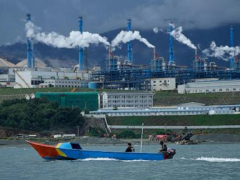

HANOI, Vietnam — Indonesia is tightening state control over the world’s largest nickel supply after years of betting the metal would anchor a homegrown electric-vehicle industry, and just as global demand begins shifting away from heavy reliance on nickel.
The move could still ripple through global EV supply chains as the United States and China compete for critical minerals. Indonesia sits at the center of the nickel market: its share of global supply jumped to about 60% in 2024 from 31.5% in 2020, according to S&P Global Market Intelligence, after former President Joko Widodo banned raw ore exports, drawing a surge of Chinese-backed investment into refining.
Jakarta hoped that control over nickel would underpin a fully domestic EV industry, from mining and batteries to finished cars. Experts say that promise was used to justify forest clearing and mining expansion in the name of the energy transition, even as climate risks deepened.
In 2025, Indonesia cracked down on what it called illegal exploitation of natural resources, saying many mining and plantation licenses were tainted by bribery or never properly approved. Authorities say they have seized more than 4 million hectares (9.8 million acres) of mines, palm oil plantations and processing sites, levied $1.7 billion in fines, and could seize another 4.5 million hectares this year.
But analysts warn the crackdown is coming just as nickel’s payoff is starting to fade, with many Chinese EVs shifting to battery chemistries that use far less of the metal, relying instead on iron-based designs.
“The forests have been exploited to the brim,” said Putra Adhiguna of the Jakarta-based Energy Shift Institute. “But you never got the electric-vehicle value chain.”
China plays the leading role in Indonesia’s nickel sector, using the metal to underpin its stainless steel and clean-energy industries.
The world’s largest nickel reserves are concentrated on the Indonesian island of Sulawesi, which accounts for more than half of global nickel mine production, according to the U.S.-based Institute for Energy Economics and Financial Analysis or IEEFA.
China has sourced nickel from Indonesia for decades, but the relationship deepened after Jakarta banned raw ore exports in 2020, drawing a surge of Chinese investment into smelters.
Nickel shipments to China jumped, with imports of nickel matte — a semiprocessed material used in battery chemicals and alloys — rising nearly 28-fold between 2020 and 2023, more than 90% of it from Indonesia, according to trade data. Over the same period, North and South America’s combined share of global nickel output fell from 16% to 7%, while Europe’s share dropped from 35% to 10%, according to the International Nickel Study Group, a Lisbon-based intergovernmental organization.
Meanwhile, mining drove the loss of about 370,000 hectares (roughly 914,000 acres) of Indonesian forests between 2001 and 2020 — more than in any other country — according to an analysis by the World Resources Institute. More than a third of that loss was old-growth rainforests which hold vast carbon stocks and are crucial for limiting climate change.
The heavy use of coal to run Indonesia’s nickel smelters has also slowed the country’s energy transition, adding new fossil-fuel demand even as it tries to cut emissions. A 2024