
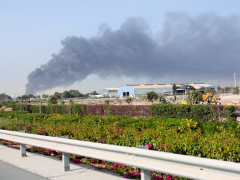

The United States-Israeli war on Iran is just one day old, and it is already clear it will have a profound impact on the Middle East and the Gulf in particular. The US-Israeli bombardment of Iran has killed a number of high-ranking officials as well as Supreme Leader Ali Khamenei. Tehran has responded by attacking not just Israel but also various countries in the region.
Saudi Arabia, Qatar, the United Arab Emirates, Bahrain, Kuwait and Oman were all struck by Iranian missiles or drones, even though none of these countries had launched attacks on Iran from their territory. Various sites across these states were targeted, including US military bases, airports, ports and even commercial areas.
If the conflict drags on, it could become a real turning point for the Gulf – one that reshapes how states think about security, alliances and even their long-term economic futures.
For years, Gulf stability has leaned on a familiar set of assumptions: The United States remained the dominant security guarantor; rivalry with Iran was managed, contained and kept below the threshold of full confrontation; and the Gulf Cooperation Council (GCC) – despite its disagreements – provided enough coordination to prevent regional politics from unravelling entirely. A sustained conflict involving the US, Israel and Iran would strain all of that at once. It would push Gulf capitals to revisit not only their defence planning but also the deeper logic of their regional strategy.
In recent years, Gulf diplomacy had already been shifting – carefully, quietly and with a strong preference for hedging rather than choosing sides. The Saudi-Iran thaw brokered by China in 2023, the UAE’s pragmatic channels with Tehran and Oman’s steady mediation role all point to the same idea: Stability requires dialogue, even when mistrust runs deep. Qatar has also kept doors open, betting on diplomacy and de-escalation as a way to reduce risk.
But a prolonged war would make that balancing act much harder to sustain. Pressure would rise from Washington to show clearer alignment. Domestic opinion would demand firmer answers about where national interests truly stand. Regional polarisation would intensify. In that kind of environment, strategic ambiguity stops looking like smart flexibility and starts looking like vulnerability because everyone wants you to pick a side.
The economic shockwaves could be just as significant. Any extended conflict tied to Iran immediately puts maritime chokepoints back at the centre of global attention, especially the Strait of Hormuz, one of th