

Hi, friends. I’m Crystal, and I write the That Got Dark newsletter, BuzzFeed’s weekly roundup of all things creepy, macabre, and horrible AF. And if you looooove this kind of content, you should subscribe!!!!!
Here’s what the newsletter is covering this week:
Warning: Graphic content ahead, including stories of murder.
1.
I recently came across a doll so deeply unsettling that I genuinely thought it had to be fake, like some AI-generated Victorian ghost child designed to haunt TikTok. But, turns out, she was very real.
In 1965, Hasbro released a doll called Little Miss No Name, and her entire concept was basically emotional manipulation. Instead of selling glamour or fantasy, the company decided to market sadness. She was intentionally designed to look like a neglected, impoverished child. She wore what looked like a tiny burlap sack for a dress. She had oversized, watery eyes with a molded tear pooling beneath them. Her short, uneven hair made her look like she’d either been through something traumatic…or was about to cause it.
So, what was the point of this doll? Apparently, the folks at Hasbro thought kids would feel so sorry for her that they’d want to “adopt” her and give her a loving home. In fact, you can see an eerie commercial for Little Miss No Name here.
Unsurprisingly, Little Miss No Name was a commercial disaster. She lasted less than a year before quietly disappearing from stores. Parents were confused. Kids were uncomfortable. And somewhere in a boardroom, someone had to admit that maybe manufacturing a guilt-based toy wasn’t the winning strategy they’d hoped for. Ironically, though, today she’s become a collector’s item — partly because of how strange she is.
2.
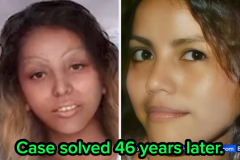
In July 1980, the body of a young woman was found in a high school parking lot in Ventura County. She had been stabbed to death and was about four months pregnant. There was no identification on her. No purse. No driver’s license. No name for investigators to use when calling out to the press. No family was immediately searching in a way that connected her to the case. For 46 years, she was only known as “Jane Doe.”
Detectives pursued leads over the decades, but without knowing who she was, everything stalled. Her pregnancy added another layer of tragedy — two lives lost, neither one able to be properly mourned. Meanwhile, her killer had already been identified…
DNA evidence eventually linked her murder to a man, Wilson Chouest, who was convicted of another killing in the 1980s and is now serving a life sentence. Authorities knew who had taken her life — but they still didn’t know who she was. That missing piece lingered for decades.
Then, this February, everything changed. Using investigative genetic genealogy — the same technique that helped identify the Golden State Killer — forensic genealogists reexamined preserved DNA evidence. They uploaded her profile into public genealogy databases and began building family trees from distant relatives who had voluntarily submitted their DNA. Cousins. Second cousins. Fragments of connection.
Piece by piece, they worked backward through generations, narrowing branches, confirming records, cross-referencing birth certificates, until finally, they arrived at her name: Maricela Rocha Parga. She was 22 years old. Finally, “Jane Doe” had a name, and a decades-old cold case is being resolved.
3.
This person’s bone-chilling experience in “creepy” US town Denton, North Carolina.
“I somehow found myself dating someone from here. I’m half Mexican, and when she took me to her town, it was very weird. She took me to the local BBQ restaurant, and she later told me the person who said ‘hi’ in the form of, ‘I’m sorry y’all lost the Civil War,’ was the wife of the local KKK’s grand dragon. Everyone in the town stared at me and gave me that, ‘I’ll smile because you’re with a local, but don’t come back’ vibe. Driving around I saw nooses in people’s yards. It was so weird and bizarre!”
North Carolina has a documented history of white supremacist violence and Ku Klux Klan activity, particularly during and after Reconstruction in the late 1800s. The Klan and similar groups used intimidation and violence to suppress Black political participation. One major episode was the 1898