
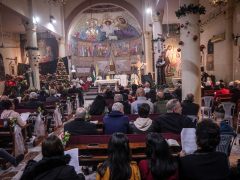

Gaza City – The Holy Family Church in Gaza has lit its Christmas tree for the first time after two years of Israel’s genocidal war on the Strip. It is Christmas Eve mass, and the worshippers have packed the main prayer hall. Many of them are excited and happy – not just because it is Christmas but because they are still alive.
The glow of lights on the big Christmas tree and holiday decorations could not hide the harsh reality left by the war on Gaza. The church decided to limit the celebrations to a prayer service and brief family gatherings, but the bells rang loud, and that alone filled people with joy.

One of those people is 58-year-old Dmitri Boulos, who missed celebrating Christmas during the war. He was displaced along with his wife and two children in the early days of the fighting after heavy Israeli shelling hit around his home in the Tal al-Hawa area, south of Gaza City.
“We fled to the church seeking safety at the time, but it turned out there was no safe place,” Boulos said. “The church was hit twice while we were inside, and we lost friends and loved ones during that period.
“Nothing had any taste at all,” he recalled. “There was immense fear and grief for those we lost. How can we celebrate when everything around us is wounded and sad?”

Boulos hopes this Christmas and the new year will bring an end to all the suffering and lift restrictions on Gaza.
“We are trying to make ourselves and our children feel that what’s coming will be better, even though the reality is extremely hard,” he said. “We hope things will return to how they were before.”
The Holy Family Church, the only Catholic parish in Gaza, has long held symbolic importance beyond the Strip. Throughout the war, the late Pope Francis called the parish almost daily, maintaining a direct line to the besieged community.
Most of Palestine’s Christians live in the occupied West Bank and East Jerusalem, totalling approximately 47,000 to 50,000, with an additional 1,000 in Gaza before the war.
The number of Christians in Gaza has dwindled in recent years. Today, there are a few hundred left, a sharp drop from the 3,000 registered in 2007.
During the war, Israeli attacks targeted several Christian places of worship where many displaced Palestinians were taking shelter.
Although the Holy Family Church was not placed by Israel in the zones marked for expulsions, the other churches in Gaza City, including the Greek Orthodox Church of Saint Porphyrius and the Anglican St Philip’s Church, were.
But the nearly 550 displaced people sheltering in the Holy Family Church still mistrust the Israeli military. The church has been attacked so many times before – despite Israeli guarantees that it does not target places of worship.
Many of those people remain traumatised and try to rebuild the semblance of a normal life.
“My heart is still heavy with the tragedies and exhaustion we lived through during the war,” Nowzand Terzi told Al Jazeera, as she stood outside the Holy Family Church’s courtyard watching the worshippers without engaging them.

“We were displaced here under bombardment two years ago. I lost my home in an Israeli strike, and then I lost my daughter, who fell suddenly ill last year and passed away,” said Terzi as her voice choked after remembering her 27-year-old daughter – who did not make it on time to hospital because of the war.
“May God help those who have lost their loved ones, and may conditions in the Gaza Strip calm down,” she said, wishing peace and safety for all.
It’s a wish that resonates across the Gaza Strip, where nearly two million people are dealing with continued Israeli attacks and violations of the ceasefire, lack of food, lack of medicine, lack of shelter and basic services.
More than 288,000 families in Gaza are enduring a shelter crisis as Israeli restrictions on humanitarian supplies worsen conditions for Palestinians displaced by the war, the territory’s Government Media Office says.
More than 80 percent of buildings across Gaza have been damaged or destroyed during the war, according to UN figures, forcing enormous displacement.
Edward Sab