
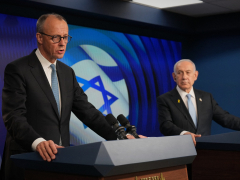

German Chancellor Friedrich Merz has affirmed support for the creation of a Palestinian state, while Israeli Prime Minister Benjamin Netanyahu has again rejected such a move, during the German leader’s inaugural visit to the country.
At a joint press conference on Sunday following a meeting in Jerusalem, the two leaders spoke of their respective priorities for Gaza and the occupied West Bank.
Recommended Stories
list of 4 items
- list 1 of 4Berlin shutdown of pro-Palestine conference was unlawful, court rules
- list 2 of 4Top global arms producers’ revenues surge as major wars rage: SIPRI report
- list 3 of 4Germany’s Merz makes first visit to Israel as chancellor amid strained ties
- list 4 of 4What has Germany’s position been on Israel’s genocide in Gaza?
end of list
Merz’s trip is playing out under the shadow of Israel’s genocidal war on Gaza – although Merz, leader of one of Israel’s staunchest supporters, does not consider it a genocide.
Merz told the news conference that Germany, one of Israel’s most unwavering allies, wanted a new Middle East that recognised a Palestinian state alongside the State of Israel.
“Our conviction is that the prospective establishment of a Palestinian state alongside Israel presumably offers the best prospect for this future,” the German chancellor said.
But he said his government had no intention of recognising a Palestinian state “in the foreseeable future”.
“The German federal government remains of the opinion that recognition of a Palestinian state should come at the end – not the beginning – of such a process (peace negotiations),” he said, putting Germany at odds with several other key European nations, including France, Spain and the Untied Kingdom, who have all confirmed formal recognition.
But Netanyahu said that the Israeli public was opposed to any two-state solution, and that the political annexation of the occupied West Bank – a concern raised by Merz and also rejected by the administration of United States President Donald Trump – remained a subject of discussion, although the status quo was expected to remain for the foreseeable future.
“The purpose of a Palestinian state is to destroy the Jewish state,” Netanyahu claimed without expanding.
The Israeli premier added that the first phase of Trump’s Gaza plan was nearly completed, and that he would be having “very important conversations” at the end of December on how to ensure the second phase would be achieved.
He would also meet Trump later this month, he added.
Relationship strained over Gaza
The war on Gaza has tested the traditionally strong ties between Israel and Germany, for whom support for Israel is a core tenet of its foreign policy, built in during decades of historical guilt over the Third Reich’s Holocaust.
In August, Israel’s actions in Gaza drove Germany – Israel’s second-largest arms supplier after the US – to restrict sales of weapons for use in Gaza. At the time, Merz said – in a public criticism of Israel that was rare for a German leader – that his government could no longer ignore the worsening toll on civilians in the besieged and bombarded enclave.
Netanyahu expressed his anger at the restrictions, which were lifted two weeks ago.
Speaking at the news conference, Merz said the decision to restrict weapons sales had changed nothing “in our very basic attitude towards Israel and Israel’s security, in our support of Israel, in our military support of Israel as well.”
No reciprocal visit on cards
Merz’s visit – coming seven months since he assumed power – has co