
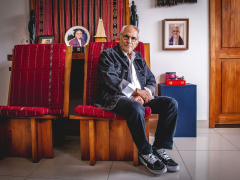

Dili, East Timor – On the 50th anniversary of Indonesia’s invasion of East Timor, longtime independence advocate and now the country’s President Jose Ramos-Horta reflected on the last half-century of politics and diplomacy in his country.
Ramos-Horta was serving as the foreign minister of the newly declared Democratic Republic of East Timor in the days leading up to Indonesia’s invasion in December 1975.
Recommended Stories
list of 4 items
- list 1 of 4‘Dream realised’: East Timor becomes ASEAN’s 11th member
- list 2 of 4Asia’s youngest nation East Timor, declared ASEAN’s 11th member
- list 3 of 4Indonesia makes former president Soeharto posthumous national hero
- list 4 of 4Who was Soeharto, the late leader named Indonesia’s ‘national hero’?
end of list
Formed by the independence party Fretilin after colonial Portugal’s withdrawal from the country, the new government in East Timor’s capital Dili was under pressure from Indonesia and its threat of invasion.
As the danger intensified, Ramos-Horta flew to the United Nations in New York to plead for international recognition and protection for East Timor’s fragile independence. Despite unanimous support at the UN for Timorese self-determination, Indonesian troops launched their invasion on December 7, 1975.
Ramos-Horta’s colleagues, including Prime Minister Nicolau Lobato and other Fretilin leaders, either went into hiding or were killed in the ensuing attack. Unable to return home, Ramos-Horta became East Timor’s voice in exile for the next 24 years.
During his exile, Ramos-Horta lobbied governments, human rights organisations, and the UN to condemn Indonesia’s occupation, which resulted in the deaths of an estimated 200,000 Timorese through conflict, famine, and repression.
Silenced by a military-imposed media blackout for much of the 1980s, it was only in the 1990s that reports of Indonesian atrocities – including the 1991 Santa Cruz massacre – began to filter out and East Timor’s struggle for independence gained international attention.
Ramos-Horta’s tireless advocacy earned him a Nobel Peace Prize, along with Bishop Carlos Belo, in 1996.
A UN-sponsored referendum delivered an overwhelming vote for independence in 1999, leading to a fully independent East Timor in 2002. However, the country continues to face economic challenges and remains one of Southeast Asia’s poorest nations.
In the years overseeing his country’s transition from conflict to reconciliation, Ramos-Horta has held the roles of foreign minister, prime minister and now president.
Al Jazeera’s Ali MC sat down with Ramos-Horta on a recent trip to East Timor, where the president spoke about his country’s long road to peace and hopes for it to prosper from membership of the Association of Southeast Asian Nations (ASEAN), increased trade with China, and development of the offshore Greater Sunrise gas field.
Al Jazeera: Reflecting on your role as an ambassador for East Timor after Indonesia’s 1975 invasion, what were some of the key challenges that you faced while advocating for your country on the international stage?
Ramos-Horta: First, we were in the midst of the Cold War with that catastrophic US engagement in the wars against North Vietnam, Cambodia and Laos.
Then, you can say – the US defeat, if not military defeat, it was a total political defeat at the hands of the Vietnamese. So, it was in the midst of all of this that Indonesia invaded Timor-Leste [the official Portuguese-language name for East Timor], on December 7, 1975. The day before, US President Gerald Ford and Secretary of State Kissinger were in Jakarta, and they officially gave the green light to President Soeharto to invade – immorally – with the use of American weapons.
So, it was within this context that it was very challenging for us to mobilise sympathy, support and the media. The invasion merited only one small, short column in The New York Times.
In Australia, there was more coverage. But the coverage didn’t last long, because Indonesia did a very good job, with Australian complicity, in blocking any news out of East Timor. At that time, not a single journalist came – the first foreign journalist to come here was in 1987.
The absence of [proof of] death is the worst enemy of any struggle. There were terrible massacres on the day of the invasion, hundreds of people shot and dumped into the sea, including an Australian, Roger East [a journalist killed by Indonesian forces on the day of the invasion].
Many, many countless people shot on the spot. Many were alive and dragged to the port of Dili, shot and fell into the sea. Many more killed randomly around town. And zero media coverage, not a single camera.

AJ: How did that lack of media coverage make it difficult for you, as an ambassador overseas, to describe to the international community exactly what was happening in East Timor?
Ramos-Horta: Terribly difficult.
To mobilise people who are potentially sympathetic, you can do so effectively if you have a backup for what you say, what you allege, what you report. This must be backed up with visuals.
But people were sympathetic and listened to me. I was persuasive enough for them to believe what might be going on.
AJ: Given your own personal experience in the struggle for independence in East Timor, does that influence the way that you advocate? Does that bring a more personal response to your diplomacy?
Ramos-Horta: My personal instinct as a person is not shaped by anyone, by any school, any religion. It is me, always, against injustice and abuse.
Then came our experience and the fight for independence. When we fought for independence and for freedom, I went around the world begging for support, begging for sympathy. Then, we became independent.
Well, how can I not show sympathy in a real way towards the Palestinians? Why would I not show sympathy in a real way towards the people of Myanmar? Just showing sympathy, because we cannot do much more.
What can we do? We are not even a mid-sized country. But speaking out – a voice – is very important.
AJ: What are your reflections on what has occurred in Gaza?
Ramos-Horta: It is one of the most abominable humanitarian catastrophes in modern times, in the 21st century, next to the killing fields in Cambodia during Pol Pot’s regime.
The amount of bombs dropped on Gaza is more than the combined amount of the bombs dropped on London and Dresden during World War II, and more than the bombs dropped on Cambodia by the Americans during the Vietnam War.
The suffering inflicted on civilians, women and children is just unbelievable.
How we, human beings in this 21st century, can descend so low and how Israel, a country that I always admired, firs