
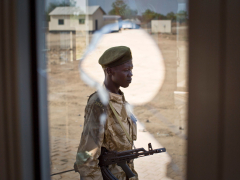

South Sudan’s army, following territorial losses in recent weeks, has announced a major military operation against opposition forces, raising fears for civilian safety.
In a statement on Sunday, army spokesman Lul Ruai Koang said Operation Enduring Peace would commence as he ordered civilians to evacuate three counties in Jonglei state immediately. He directed aid groups to leave within 48 hours.
Recommended Stories
list of 3 items
- list 1 of 3Why VP Machar’s trial presents ‘existentially high’ stakes for South Sudan
- list 2 of 3UN warns of conflict in South Sudan amid reports of VP Riek Machar’s arrest
- list 3 of 3Sudan sources say South Sudanese among captured RSF members as war rages
end of list
Koang told The Associated Press news agency on Monday that the operation aims to recapture towns recently seized by opposition forces and “re-establish law and order”.
“The country is not at war,” Information Minister Ateny Wek Ateny told reporters in Juba on Tuesday. “We are only stopping the advancement” of the opposition forces, he said.
However, this came days after a senior army commander was filmed urging his troops to kill civilians and destroy property in the Jonglei offensive, drawing rebuke from the United Nations and others.
“It is now indisputable: South Sudan has returned to war,” said Alan Boswell, the International Crisis Group’s project director for the Horn of Africa. “It is incredibly tragic for a country that only grows weaker and poorer.”
Here’s what to know about the resurgence of violence in South Sudan:
Government’s battlefield losses
Beginning in December, a coalition of opposition forces seized a string of government outposts in central Jonglei, a region that is the homeland of the Nuer ethnic group and an opposition stronghold.
Some of those forces are loyal to opposition leader Riek Machar, while others consider themselves part of an ethnic Nuer militia called the White Army. White Army fighters have historically fought alongside Machar but consider themselves a distinct group.
Machar, an ethnic Nuer, was made the most senior of five vice presidents under a 2018 peace agreement that ended fighting between his forces and those loyal to President Salva Kiir, an ethnic Dinka, the country’s largest group.
That five-year civil war was waged largely along ethnic lines, killing an estimated 400,000 people.

Suspension of government’s number two
There has been a resurgence of violence in the past year, with sporadic fighting.
Machar was suspended last year as South Sudan’s number two after White Army fighters overran a military garrison in the town of Nasir. He now faces treason and other charges over that attack, which authorities allege Machar helped orchestrate. But Machar’s allies and some international observers say the charges are politically motivated. He remains under house arrest while his trial unfolds slowly in the capital, Juba.
Machar’s trial is widely seen as a violation of the 2018 peace agreement. Yet Kiir and his allies say the agreement is still being implemented, pointing to a faction of the opposition still in the unity government.
Forces loyal to Machar have declared the agreement dead, and have since ratcheted up pressure on the army by seizing armouries and launching hit-and-run attacks on government positions. The government has relied largely on aerial bo