
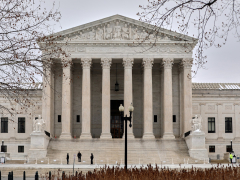

The United States Supreme Court has struck down US President Donald Trump’s sweeping tariffs that he pursued under a law meant for use in national emergencies, rejecting one of his most contentious assertions of his authority in a ruling with crucial implications for the global economy.
The decision on Friday comes after Trump leveraged tariffs – taxes on imported goods – as a key economic and foreign policy tool.
Recommended Stories
list of 4 items
- list 1 of 4Thai police disguised in dancing lion costume arrest wanted man
- list 2 of 4A timeline of British royal sagas and scandals down the decades
- list 3 of 4Ukraine to boycott Paralympic Games ceremony due to Russian participation
- list 4 of 4In Gaza, Trump’s Board of Peace met with deep scepticism, little hope
end of list
They have been central to a global trade war that Trump initiated after he began his second term as president, one that has alienated trading partners, affected financial markets and caused global economic uncertainty.
The justices, in a 6-3 ruling authored by conservative Chief Justice John Roberts, upheld a lower court’s decision that the Republican president’s use of this 1977 law exceeded his authority.
Roberts, citing a prior Supreme Court ruling, wrote that “the president must ‘point to clear congressional authorization’ to justify his extraordinary assertion of the power to impose tariffs,” adding: “He cannot.”
Trump, in comments at a news conference, condemned the ruling as “terrible” and said it was “deeply disappointing”, lashing out at the six justices who ruled against him.
“I’m ashamed of certain members of the court – absolutely ashamed – for not having the courage to do what’s right for our country,” Trump said. “Those justices are a disgrace to our nation.”
The Supreme Court reached its conclusion in a legal challenge by businesses affected by the tariffs and 12 US states, most of them Democratic-governed, against Trump’s unprecedented use of this law to unilaterally impose the import taxes.
It is the first big piece of Trump’s broad agenda to come squarely before the nation’s highest court, which he helped shape with the appointments of three conservative jurists in his first term.
The majority found that the Constitution “very clearly” gives Congress the power to impose taxes, which include tariffs. “The Framers did not vest any part of the taxing power in the Executive Branch,” Chief Justice John Roberts wrote.
Justices Samuel Alito, Clarence Thomas and Brett Kavanaugh dissented.
“The tariffs at issue here may or may not be wise policy. But as a matter of text, history, and precedent, they are clearly lawful,” Kavanaugh wrote in the dissent.
The majority did not address whether companies could get refunded for the billions they have collectively paid in tariffs. Many companies, including the big-box warehouse chain Costco, have already lined up for refunds in court, and Kavanaugh noted the process could be complicated.
“The Court says nothing today about whether, and if so how, the government