
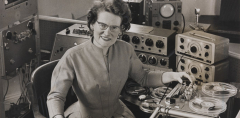

Daphne Oram (1925–2003) was one of Britain’s most important early electronic composers. Oram trained first as a pianist and composer and turned down a place at the Royal College of Music to work at the BBC, where late-night tape experiments and hands-on work with microphones and oscillators drew her from conventional composition into pioneering electronic sound.
In 1958 she co-founded the BBC Radiophonic Workshop, a studio set up to create sound effects and electronic scores for radio and TV. On the wall she pinned a passage from Francis Bacon’s 17th-century utopia New Atlantis about imaginary sound-houses where scientists manipulate echoes, invent new instruments and transmit sound “in strange lines and distances”.
Bacon’s sound houses are often read now as a prophetic sketch of the modern electronic music studio.
The Workshop would famously go on to produce the Doctor Who theme, but Oram’s time there was brief. Less than a year after its opening she left, frustrated by bureaucracy and the institution’s small, utilitarian vision for what electronic sound could be.
Despite her key influence on electronic composition, Oram’s name still isn’t as mainstream as some of the ideas and technologies she helped to normalise.
This December marks her centenary, and her archive is sparking new works, releases and performances, proving her ideas are still alive and still adventurous. Here are five things you should know about this visionary woman.
1. She grew up in a household where séances were the norm
Oram’s parents were involved in the spiritualist movement and hosted séances in the family home. The idea of disembodied sound as a portal to another world was something she grew up with.
It was a household where unseen forces, signals and voices from “elsewhere” were taken seriously.
This backdrop makes Oram’s later fascination with invisible vibrations and electronic sound feel strangely inevitable.
2. She invented her own instrument, Oramics
After leaving the BBC, Oram set up Oramics Studios for Electronic Composition at her home, the delightfully named Tower Folly. Here she began building her own machine: the Oramics system.
Using strips of 35mm film, she drew shapes that controlled pitch, volume, timbre and envelope. These were then translated into sound by photo-electric cells and oscillators.
Oram was not the first to experiment with this kind of “drawn sound” system.
But Oramics was distinctive in its ambition and in the way it centred the composer’s hand, eye and imagination, humanising electronic sound.
The partially restored Oramics machine is now held by the Science Museum in London.