


Image courtesy of Buildroid
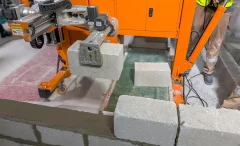
A robotic block-laying system developed by Buildroid AI places units during early field testing, part of the company’s move to link BIM-driven simulations with coordinated jobsite workflows.
Buildroid AI, a U.S.-based construction robotics startup, is preparing to enter the domestic. construction market following successful pilot projects in United Arab Emirates and backed by $2 million in new financing.
Company executives say the technology is designed to coordinate multiple robotic bricklaying across full trade sequences, using BIM-driven digital twins to test jobsite workflows before any hardware arrives on site. Buildroid plans to begin its first projects in the U.S. in 2026.
The startup, founded by construction-tech veteran Slava Solonitsyn and automation engineer Anton Glance, applies Nvidia Omniverse–powered modeling to evaluate and optimize robotic operations at scale.
Solonitsyn said the approach is intended to address historically low utilization rates that have hindered earlier attempts to automate construction tasks.
“By running thousands of Nvidia Omniverse–powered digital twin simulations before ever sending a robot to a job site, we can identify the workflows that deliver the highest impact and ensure viable economics from day one,” Solonitsyn said in the company’s announcement.
The start-up’s pre-seed funding round, led by venture capitalist Tim Draper, will support Buildroid’s first U.S. activations under a shared-savings model in which the company receives 50% of net efficiency gains and guarantees performance metrics related to throughput and quality.
How the Simulation-First Platform Works
The initial commercial focus targets blockwork and partition-wall installation—segments Buildroid identifies as persistent bottlenecks for general contractors. For that first application, Glance said Buildroid has integrated two types of block-laying robots and an autonomous mobile robot for material handling.

Buildroid’s block-laying robot positions a masonry unit during pilot testing,
part of the company’s simulation-driven approach to coordinating multi-robot
construction workflows.
Image courtesy of Buildroid
The block-laying systems can place units weighing up to 40 kg and build walls up to 4 m wide and 3 m tall, he said.
Buildroid software uses hierarchical task network planning for high-level sequencing and behavior trees for local task execution. The system performs iterative simulation cycles to validate plans based on cost, time or the number of robots.
“Validation occurs through multiple iterations of scenarios aimed at achieving the desired optimization function,” Glance said in an email to ENR.
A central component of the platform is its BIM ingestion workflow. Buildroid h