

Rachel Haganand
Mark Poynting,Climate Reporter
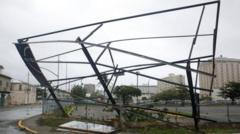
Strong winds and wild waves in Kingston, Jamaica
A very powerful hurricane has made landfall in Jamaica and is the strongest storm to hit the Caribbean island in modern history.
Hurricane Melissa, now a Category 4 storm, first hit the island’s southern coast with maximum sustained winds of 295km/h (185mph) – the strongest on Earth so far this year.
Those speeds are above those of Hurricane Katrina in 2005, one of the worst storms in US history.
For a nation already living on the front lines of a changing climate, the threat is grave.
So why is this particular hurricane so dangerous?
Follow live updatesHow do hurricanes form and are they getting stronger?How Melissa became a Category 5 monster
Tropical Storm Melissa took shape last Tuesday before rapidly strengthening as it moved west through the Caribbean.
A hurricane forms when warm, moist air rises from the ocean surface and creates a spinning system of clouds and storms. In the centre, air sinks, creating the eye, a calm, cloud-free zone surrounded by a wall of violent winds and rain known as the eye-wall.
Melissa’s origins trace back to a cluster of thunderstorms off the coast of West Africa in mid-October. By 21 October it had reached tropical storm strength and by 26 October, it was a Category 4 beast churning through the Caribbean Sea.
Ocean temperatures in the Caribbean are unusually high this year and hurricanes feed off that warm layer of water. Those conditions allowed Melissa to intensify quickly.
“The ocean is warmer and the atmosphere is warmer and moister because of [climate change],” says Brian McNoldy, senior research associate at the University of Miami.
“So it tips the scale in favour of things like rapid intensification [where wind speeds increase very quickly], higher peak intensity, and increased rainfall.”
Low pressure and violent winds
Melissa ranks as one of the strongest storms in the Atlantic this century.
For Jamaicans, the comparisons with past storms are chilling. If it strikes Jamaica at close to full strength, it could eclipse all the storms the island has experienced before. Gilbert in 1988, the last direct hit, was a Category 3. It destroyed thousands of homes and killed 49 people. Dean in 2007 and Beryl in 2024 came close, but neither matched Melissa’s power.
The storm’s central air pressure dropped to 892 millibars as of the National Hurricane Center’s advisory on Tuesday morning local time, below Hurricane Katrina’s 902 mb. The lower the pressure, the more violent the winds – making this one of the most powerful systems ever to form in the Atlantic.
Hurricane Katrina, which hit New Orleans in 2005, killed 1,392 people and caused damage estimated at $125bn (£94bn).
“This is going to be the strongest hurricane that’s ever hit [Jamaica], at least in the records we have,” Dr Fred Thomas, a research software engineer at Oxford University’s Environmental Change Institute, told the BBC.
The storm has been blamed for four deaths in Haiti and the Dominican Republic. Jamaica’s minister of health said on Monday that three people had died on the island while preparing for the approaching storm.
Melissa strengthened particularly quickly, fuelled by very warm waters in the Caribbean, around one to two degrees above average.
“There has been a perfect storm of conditions leading to the colossal strength of Hurricane Meli
Read More