
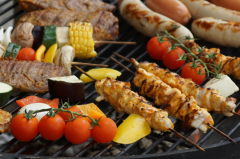

Learn how to barbecue safely with tips on marinades, lean meats, fish, plant options, and reducing harmful chemicals.
People love to barbecue. It’s not only outdoor barbecues, with tongs in one hand and a drink of choice in the other, that we are talking about. Stovetop grilling or pan-frying are indoor forms of this style of cooking where heat is applied directly to the food, usually from below, via a heated surface. It’s an easy way of cooking that adds flavour. If you are barbecuing outdoors, there is usually an added social dimension to the process. If we are honest, though, not everything about this cooking method is good news. Given the barbecue’s popularity, it is worth finding ways to make this style of cooking as healthy as possible.
HCAs and PAHs
The bad news when it comes to barbecues are chemicals known as heterocyclic amines (HCAs) and polycyclic aromatic hydrocarbons (PAHs). Both HCAs and PAHs are formed when muscle meat such as beef, pork, poultry or even fish is cooked using high temperatures, typically over an open flame or in a pan. The bad thing about HCAs is that they are mutagenic, which means they cause changes in DNA that can increase the risk of cancer.
HCAs are formed when amino acids, the building blocks of protein, react at high temperatures with sugars and a substance found in muscle called creatine. PAHs are formed when fat and juices from meat that is grilled over an open fire drip into the fire leading to flames. The flames contain PAHs that can stick to the surface of the meat.
Exactly how many HCAs and PAHs form depends a lot on the types of meat you are cooking and how you are cooking them. The more “well done” you cook your meat, the more HCAs will form. Regardless of the type of meat you cook, though, if you cook at high temperatures above 148 degrees Celsius or cook for a long time, HCAs will form. If you use a cooking method that involves exposure to smoke, as is often the case with barbecues, then PAHs will also form.
The Evidence
There are many epidemiological studies (those that look for where disease occurs in populations and why) linking high-heat cooking temperatures of meat with cancer. One particularly useful meta review was published in the journal Nutrition and Cancer. The review involved searching through two decades’ worth of research for studies that had sought to examine a potential link between HCAs, high-temperature-cooked meat and cancer. Only studies that assessed both meat intake by high-temperature cooking and meat “doneness” were included in the analysis. The conclusion was that high consumption of well-done meat and therefore greater exposure to HCAs increased the incidence of cancers including colorectal, breast, prostate, pancreas, lung, stomach and oesophagus. That’s bad news for barbecue fans but the good news is with a little planning and maybe a small change to the grill menu, you can still enjoy the odd barbie.
Marinades and Herbs
Marinating is the action of soaking food in liquid. The word comes from the French word “mariner”, which, from at least the 17th century, means to “pickle in sea brine”. The liquid that is used to soak your meat, fish or vegetable is called the “marinade”. Of course, the practice of marinating goes back into the mists of time, but for you barbecuers, marinating might be a modern saviour.
Researchers from Kansas State University published a study in the Journal of Food Science, which looked at the effects of marinating meats before cooking them on a high-temperature grill. This wasn’t a case of developing haute-cuisine marinades, either. These were commercially available marinades of three types: Caribbean, southwest and herb. For the study, steaks were marinated for one hour and then grilled at 204 degrees Celsius. The researchers measured HCA formation and found that the Caribbean blend reduced HCAs by 88 per cent compared to no marinade, the herb blend reduced them by 72 per cent and the southwest marinade reduced them by 57 per cent. It is the herbs and spices in these marinades that are yielding the reduction in HCA formation.
Another study in the Journal of Food Science tried adding extracts of rosemary to ground beef patties that were cooked at either 204 or 190 degrees Celsius for six minutes each side. Even low-concentration rosemary extracts were effective at reducing HCAs.
In a study from Kansas State University, researchers found that mixing ground steak with black pepper and standard herbs and spices reduced HCA formation to virtually zero. The most effective herbs and spices were rosemary (again), thyme, oregano, basil, sage, marjoram and cloves.
That makes a tasty little menu for you to choose from as a way to reduce HCA formation and bring some zing to your grill. The other interesting thing these researchers note when it comes to marinades is that while you might think that a longer marination would be better, you would be wrong. In fact, a one- to-two-hour marinating time of your barbecue beef is ideal as more time spent marinating actually reduces the effectiveness of the marinade since the antioxidant ingredients start to breakdown.
Herbs and marinades are front-line barbecue HCA reducers but there are other things you can try as well.
Go Plants
There is plenty of evidence that suggests a plant-based diet reduces cancer risk and is better for your overall heart health. That isn’t just due to the effect of HCAs, as plants contain many health-promoting substances and lack the fats and so on of animal foods. In this context, though, it is true that plants don’t contain the substances that lead to HCA formation and so you should look at making plant foods your most common grill choices. Asparagus, eggplant, zucchini, capsicum, corn and, everyone’s grill favourite, onion are delicious yet healthy options.
Go Fish
If you are keen to have some animal protein on your barbecue, then think about making fish your first option. Fish requires less time on the grill than other meats and therefore has a lower exposure to carcinogens. Remember, too, that PAHs form when fats drip into the fire. Although fish