
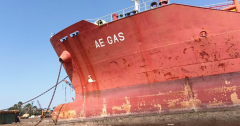

Alang, India – Standing on the windswept coastline of the Arabian Sea in the western Indian state of Gujarat, Ramakant Singh looks towards the empty, endless horizon.
“In the olden days, ships lined up at this yard like buffaloes before a storm,” says the 47-year-old. “Now, we count the arrivals on our fingers.”
Recommended Stories
list of 4 items
- list 1 of 4Is Trump’s $686m F-16 upgrade for Pakistan a message to India?
- list 2 of 4How India plans to continue buying Russian oil despite sanctions
- list 3 of 4Photos: Angry fans vandalise India stadium after Messi’s early departure
- list 4 of 4What New Delhi can learn from China’s war on air pollution
end of list
Ramakant works at Alang — the world’s largest ship-breaking yard, located in Bhavnagar district of Gujarat, Prime Minister Narendra Modi’s home state. For two decades, Ramakant has cut apart vessels as large as oil tankers and cargo carriers that sailed in from Europe and other Asian countries for his livelihood.
With its unique tidal pattern and gently sloping beach, Alang in the 1980s became the backbone of India’s ship recycling industry, where ships could be beached and dismantled at a minimal cost.
Over the decades, more than 8,600 vessels — collectively weighing roughly 68 million tonnes of light displacement tonnage (LDT), which is the actual weight of a ship without fuel, crew and cargo — have been taken apart here, accounting for nearly 98 percent of India’s total and about a third of the global ship recycling volume.

Across the world’s oceans, an ageing fleet of cargo ships, cruise liners, and oil tankers is nearing the end of its life. Of the roughly 109,000 vessels still in service, nearly half are more than 15 years old — rusting giants that will soon be retired.
Each year, close to 1,800 ships are declared unfit to sail and sold for recycling. Their owners pass them on to international middlemen, known as cash buyers — operating out of global shipping hubs such as Dubai, Singapore, and Hong Kong. These brokers, in turn, resell the vessels to dismantling yards in South Asia, where the final act of a ship’s life unfolds.
In Alang, ships are driven ashore at high tide — a process called beaching. Once grounded, hundreds of workers cut them apart piece by piece, salvaging steel, pipes, and machinery. Almost everything — from cables to cupboards — is resold for use by construction and manufacturing industries.
However, over the past decade, the number of ships arriving on Alang’s coast has dwindled. Once a skyline of giant hulls that looked like high-rise buildings against the town’s asbestos roofs, only a few cruise ships and cargo carriers dot the horizon today.
“Earlier, there was plenty of work for everyone,” Chintan Kalthia, who runs one of the few yards still open, tells Al Jazeera. “Now, most of the workers have left. Only when a new ship beaches do a few come back to Alang. My own business is down to barely 30-40 percent of what it used to be.”
According to data from India’s Ship Recycling Industries Association, 2011-12 marked Alang’s busiest financial year since it began operations in 1983, with a record 415 ships dismantled. Since then, the yard has faced a steep decline — of the 153 plots developed along the 10km (6-mile) coastline, only about 20 remain functional, and even they are operating at barely 25 percent capacity.
“But what’s going wrong in Alang has multiple reasons,” says Haresh Parmar, secretary of the Ship Recycling Industries Association (India). “The biggest is that globally, shipowners are not retiring their old vessels. Post-COVID, a surge in demand led to record profits in shipping. With freight rates soaring, owners are pushing ships beyond their usual operational life instead of sending them for dismantling.”

A key factor behind the surge in freight rates is global disruptions. Israel’s genocidal war in Gaza has had a ripple effect on global trade routes, with Yemen’s Houthi rebels repeatedly attacking commercial vessels in the Red Sea in solidarity with the Palestinians. The resulting security crisis has forced ships to bypass the Suez Canal and instead take the longer Cape of Good Hope route, sending freight rates soaring and delaying cargo worldwide.
Similarly, an analysis by the United Nations Conference on Trade and Development (UNCTAD) conducted in June 2022 found that the Russia-Ukraine war and other Middle East tensions had pushed up marine fuel costs by more than 60 percent, adding to operational expenses and shipping delays.
Together, these factors have sharply reduced the supply of end-of-life ships heading to Alang. “When owners are earning well, they don’t scrap their vessels,” says Parmar. “That’s why our yards are standing empty.”
Compliance raising costs
But that is not the only reason why Alang is struggling.
India’s ship recycling industry has undergone a significant transformation since the country acceded to the Hong Kong International Convention for the Safe and Environmentally Sound Recycling of Ships (HKC) in November 2019, becoming one of the first top ship-breaking nations to do so. Under the HKC and the 2019 Recycling of Ships Act, yards at Alang upgraded their infrastructure, installed pollution control systems, lined hazardous waste storage pits, trained workers, and maintained detailed inventories of toxic materials used in vessels.
These measures made Alang-Sosiya Ship Recycling Yards (ASSRY) one of the most compliant ship-recycling clusters in the developing world, with 106 of ASSRY yards having received HKC Statements of Compliance (SoC). Sosiya is a village located right next to Alang on the Gulf of Khambhat coast in Gujarat. Together, Alang and Sosiya form the entire stretch of beach where ship-breaking plots operate.
But achieving these standards came at a high cost: each yard had to invest between $0.56m and $1.2m to meet compliance norms, raising operational costs at a time when competition from neighbourin