
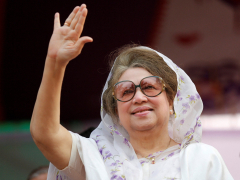

Khaleda Zia, Bangladesh’s first female prime minister and a towering figure in the country’s turbulent politics, has died at the age of 79 after a prolonged illness, according to her party.
In a statement on Tuesday, the Bangladesh Nationalist Party (BNP) said Khaleda died at 6am local time (00: 00 GMT).
Recommended Stories
list of 4 items
- list 1 of 4Bangladesh holds state mourning, funeral for slain uprising activist
- list 2 of 4Exiled Bangladeshi leader faces test to “prove his legitimacy”
- list 3 of 4Bangladesh election: Why BNP leader Tarique Rahman’s return matters
- list 4 of 4Bangladesh top court acquits ex-PM Khaleda Zia in corruption case
end of list
“Our beloved national leader is no longer with us,” the BNP said.
“We pray for the forgiveness of her soul and request everyone to offer prayers for her departed soul,” it said.
Bangladesh has declared three days of state mourning. Asif Nazrul, who holds the law portfolio in the interim government, said Khaleda’s funeral will be held on Wednesday, with funeral prayers to be held in front of parliament after midday prayers, before she is buried alongside her late husband, the assassinated former President Ziaur Rahman.
Khaleda died at the Evercare Hospital in Dhaka, where she was admitted on November 23 with symptoms of a lung infection, according to The Daily Star, a Bangladesh news website.
Her doctors said she had advanced cirrhosis of the liver, arthritis, diabetes, and chest and heart problems.
Khaleda’s death closes a chapter spanning more than three decades during which she and her rival Sheikh Hasina — who were known as the “battling begums” — dominated Bangladeshi politics. Hasina, who was forced from power last year and sentenced to death in absentia for her crackdown on student protesters, is now in exile in India.
Bangladesh’s interim leader, Muhammad Yunus, expressed his “profound sorrow” at Khaleda’s death in a statement on X.
He called the three-time prime minister a “symbol of the democratic movement” in Bangladesh and said the “nation has lost a great guardian”.
“I am deeply saddened and grief-stricken by her death,” he added.
In a television broadcast to the nation, he acknowledged it was a “deeply emotional” time for the country and appealed for calm.
“I humbly appeal to everyone to maintain discipline while observing all forms of mourning, including the funeral prayers. I know you are all deeply emotional at this time.”
Indian Prime Minister Narendra Modi and his Pakistani counterpart Shehbaz Sharif also offered their condolences.
Modi expressed deep sadness in a post on X and said Khaleda’s “important contributions towards the development of Bangladesh, as well as India-Bangladesh relations, will always be remembered”.
Sharif described Khaleda as a “committed friend of Pakistan” and said his government and the people of Pakistan stand with Bangladesh “in this moment of sorrow”.
“Her lifelong service to Bangladesh and its growth and development leaves a lasting legacy,” he added.
Reporting from outside Khaleda’s residence in Dhaka, Al Jazeera’s Tanvir Chowdhury said, while her health issues had been public knowledge for weeks, Bangladeshis were in shock at the loss of a towering figure in their country’s national life.
“The nation is in mourning,” he said.
Thousands had gathered outside the hospital where she died to show their respect, he said.
“She has always been admired,” he said. “She was at the forefront of the democratic movement.”
First female prime minister
Khaleda’s legacy, like Hasina’s, remains deeply contested.
Both women fought for democracy, against authoritarianism. But while Khaleda – unlike Hasina – was never accused of carrying out mass atrocities against critics, she too was known to be a polarising figure.
Her uncompromising style while in opposition – lea