

Crafting crisis statements & releases means delivering clear, verified, and empathetic information fast when a serious issue threatens trust and stability.
In a digital news cycle measured in minutes, delay fuels speculation and misinformation. We face moments where a data breach, safety incident, or leadership misstep demands immediate clarity.
This guide explains how we structure crisis communication to control facts, support stakeholders, and set a credible path forward. Keep reading to understand the exact frameworks, wording principles, and distribution steps that help us respond with calm authority.
Key Takeaways
- Crisis statements must lead with empathy, verified facts, and clear action commitments within the golden hour.
- A structured format prevents confusion and limits rumor spread across media and social platforms.
- Consistent follow-ups and transparent updates turn crisis response into trust rebuilding.
Crisis Statement Definition, Examples & Format
A crisis statement definition, examples & format begins with a simple truth. A crisis statement is an urgent public message issued to address a disruptive event that affects stakeholders, operations, or credibility. Unlike a standard announcement, its goal is stability, not promotion. According to Harvard Business Review, early transparency improves stakeholder confidence during high-impact incidents.
A crisis release answers five essentials. Who is affected? What happened? When and where it occurred. What we are doing now. What comes next?
Research from MIT demonstrates that false news spreads six times faster than true information, with falsehoods reaching 1,500 people approximately six times faster than truth on Twitter, underscoring why verified information and rapid, accurate communication are critical during breaking events to prevent misinformation from filling the void. [1]
We rely on a consistent structure that supports clarity under pressure. This structure also supports fast scanning by journalists and decision makers.
Common crisis formats include:
- Initial holding statement during the first hour
- Detailed crisis release after facts are confirmed
- Update statements tied to investigation milestones
Below is a simplified comparison that shows how crisis releases differ from routine announcements.
| Element | Crisis Statement | Standard Release |
| Primary goal | Stability and trust | Awareness |
| Timing | Immediate | Planned |
| Tone | Empathetic and factual | Informative |
| Content focus | Impact and actions | Features and updates |
This format ensures we control the narrative early while leaving room for updates as investigations progress.
Writing Crisis Statements With Clarity and Empathy
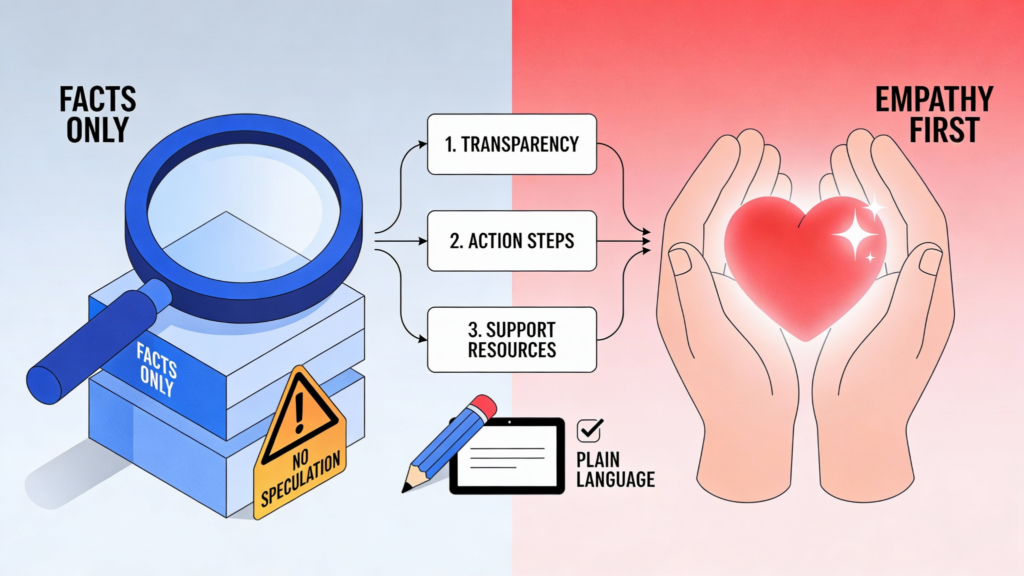
Writing crisis statements requires discipline. We start with facts only. No speculation. No assumptions. According to The Associated Press Stylebook, credibility depends on accuracy before speed, even in urgent situations.
Empathy follows facts closely. Stakeholders expect acknowledgment of impact before explanations. A short line such as “We understand the concern this situation creates for customers and employees” signals accountability without admitting unverified fault.
We also prepare three key messages before drafting. These messages guide every sentence and prevent message drift across channels.
Our three-message approach includes:
- Transparency about verified information
- Action steps crisis teams are taking now
- Support resources available to affected groups
Each paragraph stays short and direct. Plain language matters. Studies cited by Nielsen Norman Group show shorter sentences improve comprehension during stress.
Before release, we audit tone carefully. Defensive wording erodes trust. Neutral phrasing preserves credibility until investigations conclude. This balance keeps statements human while remaining responsible.
The EFA Model Crisis Framework Explained
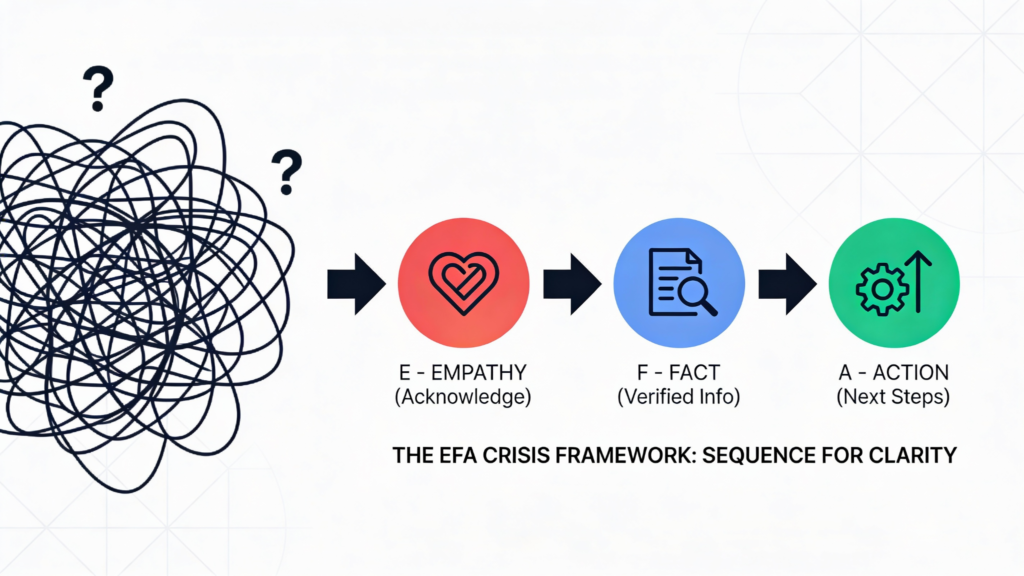
The EFA model crisis framework stands for Empathy, Fact, Action. It provides a reliable sequence when emotions are high and information is limited. Communication scholars at University of Michigan note that ordered messaging reduces perceived chaos.
Empathy always comes first. Acknowledging concern does not increase liability. It shows leadership. Fact comes next, grounded only in verified information. Action closes the loop by showing momentum and responsibility.
We apply EFA consistently across channels to maintain coherence.
EFA breakdown in practice:
- Empathy: Recognize stakeholder impact
- Fact: Share what is confirmed and what is unknown
- Action: Outline immediate and next steps
This structure reassures audiences that we are present, informed, and active.
Crisis Communication Press Release Essentials
A crisis communication press release follows a news-style format designed for rapid understanding. Editors and platforms prioritize clarity and accuracy during breaking events. According to Reuters Institute, concise leads improve pickup during crisis coverage.
We begin with a direct headline that names the issue. Avoid creative phrasing. Precision builds trust. The dateline reinforces immediacy and context.
The lead paragraph crisis section summarizes the event in one or two sentences. It includes who is affected and what actions are underway. The body then expands carefully, balancing empathy with facts.
A strong closing reassures without overpromising. We reaffirm commitment and provide contact information for updates.
Essential components include:
- Clear crisis headline and dateline
- Lead paragraph with verified facts
- Body with empathy, investigation update, and action steps
- Closing reassurance and contact info
This structure supports fast reading while preserving accountability.
Audience Tailoring and Key Messages Crisis Planning

Not all stakeholders need the same details. Audience tailoring improves relevance and reduces confusion. Research from McKinsey & Company highlights that targeted messaging increases trust retention during disruptions.
We identify primary groups early. Customers want impact clarity. Employees need reassurance. Regulators require compliance updates. Each group receives aligned but distinct messaging.
We maintain a shared message core to prevent contradictions.
Audience focus priorities:
- Customers: Service impact and support options
- Employees: Safety, stability, and expectations
- Regulators: Compliance steps and cooperation
Tailoring does not mean changing facts. It means adjusting emphasis while maintaining consistency.
Channel Distribution and Golden Hour Response
Credits: Hofstra University
Speed matters. The golden hour response refers to the first sixty minutes after a crisis becomes public. According to MIT Sloan Management Review, early communication red