
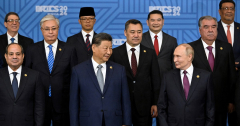

Amid rapidly accelerating international shifts, China’s foreign policy has become a complex equation. From the Middle East to Latin America, from the Asia Pacific to the Arctic Circle, Beijing is moving across a global stage with cautious pragmatism but also with an ambition to reshape centres of global influence. Intense strategic rivalry with the United States and expansionary ambitions amid renewed regional crises continue to influence its policies.
So what does this mean for the world?
The US: From rivalry to managing relations
China’s official discourse centres on the idea of “peaceful rise”, the “commitment to non-interference in internal affairs”, respect for “sovereignty and territorial integrity”, and economic partnerships based on mutual benefit. Beijing insists that relations with Washington should not slide into conflict, calling for a system of global governance built on cooperation rather than confrontation.
Yet the geopolitical landscape reveals a wide gap between this discourse and reality. Donald Trump’s return to the White House has brought back rhetorical escalation and increased geopolitical pressure. Recent US moves — such as the military intervention in Venezuela and the threat to take over Greenland — have drawn sharp condemnation from China, which saw them as a reflection of a hegemonic impulse that violates international laws and conventions.
Against this tense backdrop, China’s strategy reflects meticulous calculations that go beyond official rhetoric. In practical terms, it seeks to exploit international conditions, especially transatlantic tensions, to undermine traditional alliances.
Beijing sees the Trump administration’s erratic behaviour as an opportunity to weaken trust between Europe and the US. By presenting itself as a stable economic power that can be relied upon, China seeks to encourage European partners to question their traditional security dependence on Washington. It aims to bolster the concept of European “strategic autonomy”, diminishing transatlantic security linkage and thus weakening transatlantic solidarity in the face of Chinese long-term policies.
Iran and Syria in China’s calculations
China’s policy towards regional crises such as those in Iran and Syria is characterised by a careful blend of economic interest and geopolitical considerations. Beijing does not view its cooperation with Tehran as merely a commercial partnership; rather, it is a pillar of its broader strategy to secure energy security and diversify global trade routes under the umbrella of the Belt and Road Initiative.
China places particular emphasis on developing overland corridors through Iran towards Eurasia, which constitute a strategic land-based alternative aimed at reducing reliance on sensitive maritime routes exposed to geopolitical risks such as the Strait of Hormuz, the Strait of Malacca, and the Suez Canal.
In Syria, China’s stance focuse