
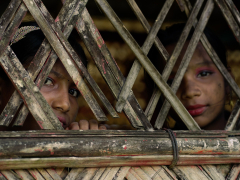

Cox’s Bazar, Bangladesh – On a Thursday afternoon, 19-year-old Mahmudul Hasan prepared seating on the floor of his bamboo-and-tarpaulin home in Balukhali Rohingya Refugee camp.
Minutes later, 35 young children trooped in. Hasan is still in his teens, but he is their teacher. They greeted him in Rakhine language: “Sayar, Nay Kaung Lar? [Sir, how are you?]” The children are among 80 who study at Hasan’s community-run private school, where he teaches them Burmese, English and maths.
But nearby, a Bangladeshi government official on a motorcycle was trying to educate all those who would listen about something else: He was making announcements about the country’s upcoming February 12 elections.
Between February 9 and February 13, the official yelled out on a microphone, people in the refugee camp should keep their shops shut and not venture outside the camp. And he warned them: Anyone found participating in any political campaign would receive “serious punishment” – they could lose their registration card and a separate document that allows refugees access to subsidised rations.
The camps in Cox’s Bazar are home to more than 1 million Rohingya refugees, who were forced to flee Myanmar in 2017 after a brutal military crackdown. At a time when most countries shunned them, Bangladesh – under then Prime Minister Sheikh Hasina – gave them shelter. But the election season warnings to them were a reminder of how, at the same time, life in Bangladesh is life in limbo: Limited education, health, rations, livelihood options, and freedom of movement.
As Bangladesh’s 127 million voters prepare to elect their next government, Rohingya refugees like Hasan know that they aren’t real stakeholders.
“I don’t have any new expectations,” Hasan told Al Jazeera. “I deserve to live with dignity and human rights. This life [in Bangladesh] is not my choice.”
Still, he conceded, candidates from the two main political fronts in the election – the alliances led by the Bangladesh Nationalist Party and the Jamaat-e-Islami – in the Ukhia and Teknaf regions where the Rohingya camps are based, have spoken of the community’s concerns, as have national leaders from these parties.
That gives him some hope to cling to.
![A Rohingya family outside their temporary home in a camp in Cox's Bazar, Bangladesh [Sahat Zia/Al Jazeera]](http://www.aljazeera.com/wp-content/uploads/2026/02/DSC3080-1770189355.jpeg?w=770&resize=770%2C513&quality=80)
‘It’s not sufficient’
Hasan arrived in Bangladesh with his family when he was 10 years old in 2017, with other Rohingya refugees.
The massacre of the Rohingya in Myanmar – where the community’s members are not even considered citizens – is currently being investigated by the International Court of Justice as a possible genocide. Meanwhile, in November 2024, the International Criminal Court issued an arrest warrant against Myanmar’s military chief, Min Aung Hlaing, accusing him of committing crimes against the Rohingya in 2017.
Since then, Bangladesh has been home to the biggest chunk of Rohingya refugees globally.
But Nay San Lwin, a diaspora leader of the Rohingya and a co-chair of the Arakan Rohingya National Council (ARNC), said that while the community was grateful to Bangladesh’s government and people, the country’s policy of “non-integration” of the Rohingya meant that they remained on the peripheries of society. The camps are fenced with barbed wire, and Rohingya children can’t access the formal education system of Bangladesh, for instance.
“The elected government in February should focus on improving living conditions, access to education, healthcare, livelihoods, and fostering greater engagement between refugees and host communities,” he said.
That’s easier said than done, though. The Rohingya camps have run with financial support from the United Nations and global aid agencies – and funding cuts in recent years have hobbled the already limited services available to residents.
“The humanitarian situation continues to deteriorate due to insecurity, funding cuts, lack of education, and uncertainty about the future,” said Sayed Ullah, president of the United Council of the Rohingya, a community organisation.
Hafez Ahmed, a 64-year-old shopkeeper in the camp, said medical facilities there were getting worse. “We only got the basic medicines they provide in the hospital. If any critical illness is detected, hospitals advise us to seek treatment at private hospitals, but we don’t have the money,” he told Al Jazeera. “Rations are getting less; it’s not sufficient.”
And for young Rohingya like the teenage teacher Hasan, life in the camp is one of dashed dreams.
“Living camp life is a trauma; camp life is like prison life,” he said. “I wanted to be a world-class teacher who contributes to world education, but what can I say to myself, a fateless one?”
Growing frustrations with life in Bangladesh have led more and more Rohingya refugees to try to repeat the perilous journeys they once took to get to the c