
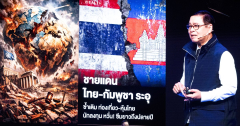

As Thailand prepares to vote on Sunday in a nationwide election, the country’s months-long border dispute with Cambodia continues to cast a shadow over election proceedings.
Brief but deadly armed clashes in May last year on a disputed section of the Thai-Cambodia border escalated into the deadliest fighting in a decade between the two countries, killing dozens of people and displacing hundreds of thousands.
Recommended Stories
list of 4 items
- list 1 of 4Thailand election 2026: What are the main parties? What do polls suggest?
- list 2 of 4As Thailand votes, can the reformist People’s Party break the cycle?
- list 3 of 4Ancient Khmer temples scarred by Thailand-Cambodia conflict
- list 4 of 4In US ally Thailand, feelings of betrayal after Trump’s visa freeze
end of list
Fallout from the conflict toppled the government of Thailand’s Prime Minister Paetongtarn Shinawatra – daughter of the billionaire populist leader Thaksin Shinawatra – before bringing Prime Minister Anutin Charnvirakul to power in September.
Now, while the fighting may have ceased, the conflict remains an emotive topic for Thais and a means for Anutin to rally support for his conservative Bhumjaithai Party as a no-nonsense prime minister, unafraid to flex his country’s military muscle when required, analysts say.
“Anutin’s party is positioning itself as the party that’s really willing to take the initiative on the border conflict,” said Napon Jatusripitak, an expert in Thai politics at the ISEAS-Yusof Ishak Institute in Singapore.
“It’s a party that has taken the strongest stance on the issue and the most hawkish,” Napon said of the recent military operations.
Anutin had good reason to focus on the conflict with Cambodia in his election campaign. The fighting created a surge in nationalist sentiment in Thailand during two rounds of armed conflict in July and December, while the clashes also inflicted reputational damage on Anutin’s rivals in Thai politics.
Chief among those who suffered on the political battlefield was the populist Pheu Thai Party, the power base of Thailand’s former prime minister Thaksin and his family.
Pheu Thai sustained a major hit to its popularity in June when a phone call between its leader, then-Thai Prime Minister Paetongtarn, and the strongman of Cambodian politics, Hun Sen, was made public.
In the June 15 call, Paetongtarn referred to Hun Sen, an erstwhile friend of her father, as “uncle” and promised to “take care” of the issue after the first early clashes between Thai and Cambodian troops, according to Reuters news agency.
For factions in Thailand’s politics and Thai people, Paetongtarn’s deference to Hun Sen was beyond the pale of acceptable behaviour for a prime minister, especially as she appeared to also criticise Thailand’s military – a major centre of power in a nation of more than 70 million people.
Hun Sen later admitted to leaking the call and claimed it was in the interest of “transparency,” but it led to the collapse of Paetongtarn’s government. She was then sacked by the constitutional court at the end of August last year, paving the way for Anutin to be voted in as Thailand’s leader by parliament the following month.
The border conflict with Cambodia has given a major boost to Thailand’s armed forces at a time of “growing popular discontent with the military’s involvement in politics, and with the conservative elite”, said Neil Loughlin, an expert in comparative politics at City St George’s, University of London.
Anutin’s go