
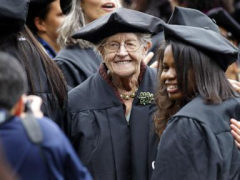

FLAGSTAFF, Ariz. — Interested in starting a business, learning about artificial intelligence or exploring a new hobby? There’s a class for that.
Millions of U.S. adults enroll in credit and non-credit college courses to earn professional certificates, learn new skills or to pursue academic degrees. Some older students are seeking career advancement, higher pay and job security, while others want to explore their personal interests or try new things.
“They might have kids, they might be working full-time, they might be older non-traditional students,” said Eric Deschamps, the director of continuing education at Northern Arizona University in Flagstaff, Arizona. But returning to school “opens doors to education for students that might not have those doors open to them otherwise.”
Older students, many of whom bring years of work and life experience to their studies, often are juggling courses with full-time jobs, caregiving and other family responsibilities. It is a challenging balancing act but can also sharpen priorities and provide a sense of fulfillment.
Here’s what experts have to say about returning to school, what to consider beforehand and how to balance coursework with work and personal commitments.
UCLA Extension, the continuing education division of the University of California, Los Angeles, offers more than 90 certificate and specialization programs, from interior design, early childhood education and accounting to photography, paralegal studies and music production. Individual courses cover a wide range of topics, including retirement planning, writing novels, the business of athletes and artists, and the ancient Japanese art of ikebana, or flower arranging.
About 33,500 students — nearly half of them older than 35 — were enrolled during the last academic year. UCLA reported a full-time enrollment of about 32,600 degree-seeking undergraduate students during the same period.
“I prefer calling our (adult) learners not only continuous, but the new majority student. These are learners who tend to already be employed, often supporting a family, looking for up-skilling or sometimes a career change,” Traci Fordham, UCLA’s interim associate dean for academic programs and learning innovation, said.
Higher education experts say some adults take classes for professional development as economic concerns, technological advances and other workforce changes create a sense of job insecurity.
“A great example of that is artificial intelligence.