
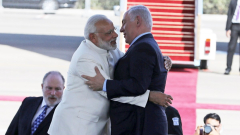

New Delhi, India – As Indian Prime Minister Narendra Modi emerged from his plane at Ben Gurion airport outside Tel Aviv on July 4, 2017, his Israeli counterpart, Benjamin Netanyahu, waited for him at the other end of the red carpet laid out on the tarmac.
Minutes later, the leaders hugged. Speaking at the airport, Modi said his visit was a “path-breaking journey” – it was the first time an Indian prime minister had visited Israel. Netanyahu recalled their first meeting in New York in 2014, where, he said, “we agreed to break down the remaining walls between India and Israel”.
Nine years later, as Modi prepares to fly to Israel on February 25 for his second visit, he can largely claim to have accomplished that mission, analysts say. A relationship that was once frowned upon in India, and then carried out clandestinely, is now one of New Delhi’s most public friendships. Modi has frequently described Netanyahu as a “dear friend”, despite the International Criminal Court having issued an arrest warrant in late 2024 for the Israeli premier over alleged war crimes carried out during Israel’s genocidal war on Gaza.
Indian diplomats and officials have justified the country’s pivot towards Israel as a “pragmatic approach” – Israel, with its tech and military expertise, has too much to offer to be ignored, they argue – balanced by efforts from New Delhi to strengthen ties with its Arab allies.
Yet, it has come at a cost, analysts say: to Palestine, and India’s relationship with it, and, according to some experts, to India’s moral credibility.
“The so-called realist turn of India has cost its moral power, which it used to enjoy in the Global South,” said Anwar Alam, a senior fellow with the Policy Perspectives Foundation think tank in New Delhi.
Amid an ongoing war in the Palestinian territory, Modi’s visit “amounts to legitimising the apartheid Israeli state”, Alam told Al Jazeera.

An ideological alliance
India was a staunch advocate for Palestine in the post-colonial world order, with major leaders backing Palestinian independence. In 1947, India opposed the United Nations plan to partition Palestine. And four decades later, in 1988, India became one of the first non-Arab states to recognise Palestine.
The end of the Cold War – India leaned towards the Soviet Union despite officially being non-aligned – forced a change in New Delhi’s calculations. Alongside an outreach to the United States, India also established diplomatic relations with Israel in January 1992.
Since then, defence ties have anchored the relationship, which has also expanded on other fronts in recent years.
Modi’s rise to power in India in 2014 proved to be the catalyst for the biggest shift in relations. Modi’s Hindu nationalist Bharatiya Janata Party (BJP) has an ideology rooted in the vision of making India a Hindu nation, a natural homeland for Hindus anywhere in the world – an approach that mirrors, in many ways, Israel’s view of itself as a Jewish homeland. Both Modi and Israel view “Islamic terrorism”, which critics say is also shorthand for justifications needed to pursue broader anti-Muslim policies, as major threats.
Under Modi, India has become Israel’s largest weapons buyer. And in 2024, as Israel waged its war on Gaza, Indian weapons firms sold Israel rockets and explosives, according to an Al Jazeera investigation.
Ahead of Modi’s upcoming visit, the two countries signed a memorandum of understanding that aims to further deepen defence ties, with India exploring the joint development of anti-ballistic missile defence with Israel. In Jerusalem, Modi is scheduled to address the Knesset, Israel’s parliament.
“Modi’s address is special because of how it underlines the scale of the shift in relations under the Bharatiya Janata Party towards an overtly pro-Israel policy,” Max Rodenbeck, project director at the Washington-based Crisis Group’s Israel-Palestine department, told Al Jazeera.
But Modi’s visit is also personal for Netanyahu, Rodenbeck said. Israel is months away from a national election that is, in effect, a referendum on Netanyahu’s government – from the intelligence failures that enabled the October 7 attack by Palestinian groups to the war on Gaza that followed, as well as his attempts to weaken judicial independence through reforms.
The visit appears “as almost a personal favour to Netanyahu by boosting his image as an international statesman just as Israeli election campaigning is getting underway”, Rodenbeck said.
While several Western leaders have visited Israel since it began its genocidal war on Gaza in October 2023, few leaders from the Global South have made the trip.
At a time when the Gaza war has shrunk the set of countries willing to