
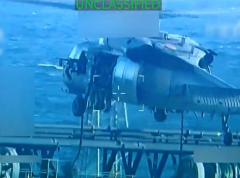

United States President Donald Trump has said that the US has seized a sanctioned oil tanker close to the coast of Venezuela, in a move that has caused oil prices to spike and further escalates tensions with Caracas.
“We’ve just seized a tanker on the coast of Venezuela, large tanker, very large, largest one ever, actually, and other things are happening,” Trump said on Wednesday.
Recommended Stories
list of 1 item
- list 1 of 1US says it seized oil tanker off Venezuela coast
end of list
The Venezuelan government called the move an act of “international piracy”, and “blatant theft”.
This comes as the US expands its military operations in the region, where it has been carrying out air strikes on at least 21 suspected drug-trafficking vessels since September. The Trump administration has provided no evidence that these boats were carrying drugs, however.
Here is what we know about the seizure of the Venezuelan tanker:
What happened?
The US said it intercepted and seized a large oil tanker off the coast of Venezuela, marking the first operation of its kind in years.
The last comparable US military seizure of a foreign tanker occurred in 2014, when US Navy SEALs boarded the Morning Glory off Cyprus as Libyan rebels attempted to sell stolen crude oil.
The Trump administration did not identify the vessel or disclose the precise location of the operation.
However, Bloomberg reported that officials had described the ship as a “stateless vessel” and said it had been docked in Venezuela.
Soon after announcing the latest operation on Wednesday, US Attorney General Pam Bondi released a video showing two helicopters approaching a vessel and armed personnel in camouflage rappelling onto its deck.
“Today, the Federal Bureau of Investigation, Homeland Security Investigations and the United States Coast Guard, with support from the Department of War, executed a seizure warrant for a crude oil tanker used to transport sanctioned oil from Venezuela and Iran,” Bondi said.
She added that “for multiple years, the oil tanker has been sanctioned by the United States due to its involvement in an illicit oil-shipping network supporting foreign terrorist organisations”.
Today, the Federal Bureau of Investigation, Homeland Security Investigations, and the United States Coast Guard, with support from the Department of War, executed a seizure warrant for a crude oil tanker used to transport sanctioned oil from Venezuela and Iran. For multiple… pic.twitter.com/dNr0oAGl5x
— Attorney General Pamela Bondi (@AGPamBondi) December 10, 2025
Experts said the method of boarding demonstrated in the video is standard practice for US forces.
“The Navy, Coast Guard and special forces all have special training for this kind of mission, called visit, board, search, and seizure – or VBSS,” Mark Cancian, a retired Marine Corps colonel and senior adviser at the Center for Strategic and International Studies, told Al Jazeera.
“It is routine, especially for the Coast Guard. The government said it was a Coast Guard force doing the seizure, though the helicopter looks like a Navy SH-60S.”
Which vessel was seized?
According to a Reuters report, British maritime risk firm Vanguard identified the crude carrier Skipper as the vessel seized early Wednesday off Venezuela’s coast.
MarineTraffic lists the Skipper as a very large crude carrier measuring 333m (1,093 feet) in length and 60m (197 feet) in width.
The tanker was sanctioned in 2022 for allegedly helping to transport oil for the Lebanese armed group, Hezbollah, which is backed by Iran, and Iran’s Quds Force.
The Skipper departed Venezuela’s main oil terminal at Jose between December 4 and 5 after loading about 1.8 million barrels of Merey crude, a heavy, high-sulphur blend produced in Venezuela.
“I assume we’re going to keep the oil,” President Trump said on Wednesday.
Before the seizure, the tanker had transferred roughly 200,000 barrels near Curacao to the Panama-flagged Neptune 6, which was headed for Cuba, according to satellite data analysed by TankerTrackers.com.
According to shipping data from Venezuela’s state-owned oil and gas company Petroleos de Venezuela (PDVSA), the vessel also transported Venezuelan crude to Asia in 2021 and 2022.
Where did the seizure take place?
The US said it seized the oil tanker in the Caribbean Sea.
US officials have said the action occurred near Venezuelan territorial waters, though they have not provided precise coordinates.
MarineTraffic data shows the vessel’s tracker still located in the Caribbean.

Is the US action legal?
Cancian noted that “seizing sanctioned items is common inside a country’s own territory. It is unusual in international waters”.
He added: “Russia has hundreds of sanctioned tankers sailing today, but they have not been boarded.”
Experts say it is unclear whether the seizure was legal, partly because many details about it have not been made public.
Still, the US could make use of various arguments to justify the seizure if needs be.
One is that the boat is regarded as stateless. Under the UN Convention on the Law of the Sea (UNCLOS), ships need “a nationality”.
The government of Guyana, Venezuela’s neighbour, said the Skipper was “falsely flying the Guyana flag”, adding that it is not registered in the country.
If a vessel flies a flag it is not registered under, or refuses to show any flag at all, states have the “right of visit”, allowing their officials to stop and inspect the ship on the high seas – essentially meaning international waters.
If doubts about a ship’s nationality remain after checking its documents, a more extensive search can follow.
In previous enforcement actions against sanctioned ships, the US has seized not the ship itself but the oil on board. In 2020, it confiscated fuel from four tankers allegedly carrying Iranian oil to Venezuela.
US law also allows the Coast Guard, which carried out this operation, to conduct searches and seizures on the high seas in order to enforce US laws, stating that it “may make inquiries, examinations, inspections, searches, seizures, and arrests upon the high seas” to prevent and suppress violations.
But some legal expe