
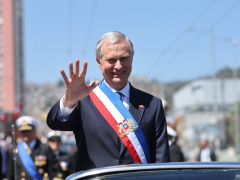

It was a symbol hiding in plain sight. On February 24, two weeks before his inauguration as Chile’s president, Jose Antonio Kast unveiled his official portrait.
The photo showed the 60-year-old leader wearing a blue suit, the presidential sash and a conspicuous coat of arms stitched in the middle.
Recommended Stories
list of 3 items
- list 1 of 3Who is Jose Antonio Kast, Chile’s newly elected far-right leader?
- list 2 of 3What’s behind South America’s shift to the right?
- list 3 of 3‘Big crisis’: Kast’s immigration agenda brings uncertainty to Chile’s north
end of list
It was conspicuous, because no president since the fall of Augusto Pinochet in 1990 had posed with the coat of arms on the sash. The last leader to do so was Pinochet himself.
For critics, the crest was another expression of Kast’s professed affinity for the former hardline leader.
But as Kast is sworn into office on Wednesday, analysts question whether his embrace of Pinochet is nostalgia for Latin America’s past dictatorships — or whether it is simply a sign of frustration with the status quo.
Maria Fernanda Garcia, the director of Chile’s Museum of Memory and Human Rights, noted that, around the world, there appears to be a shift towards more hardline policies.
She credits a “crisis of democracy” with helping to “turn a past that was full of horror in many parts of the world into something that is glorified by people who didn’t live through it.”
“It’s not what we expected after the learnings of the second world war and other conflicts and dictatorships,” Garcia added.
Still, she has observed that young people in particular are falling prey, influenced by reactionary narratives on social media.
“Rebellion these days is not against war or dictatorships, but the rebellion is against that which is established,” Garcia said. “And the established is democracy, respect for human rights.”
Who was Pinochet?
Kast won December’s presidential election with the largest vote tally in Chilean history. More than seven million Chileans cast a ballot for him in the run-off, earning him more than 58 percent of the vote.
His success came in spite of critics pointing to past statements where he showed reverence for Pinochet.
Kast had even speculated during a past race that, if Pinochet had been alive, “he would have voted for me.”
Pinochet seized power in a 1973 military coup, ousting Chile’s democratically elected leader.
Over the next 17 years, he carried out a campaign of systemic repression against his political opponents, resulting in the death of more than 3,000 people. Thousands more were imprisoned and tortured.
Kast was a young man at the time of the dictatorship. But even then, he participated in a youth campaign to keep Pinochet in power.
While Kast downplayed those ties during his most recent presidential race, the connection to Pinochet has been part of his personal brand for most of his political career.
Felipe Gonzalez Mac-Conell, author of the book Kast: The Chilean Far-Right, explained that the influence of Pinochet’s government can be linked to Kast’s embrace of neoliberal economics and his conservative approach to issues like crime and women’s rights.
“What has permeated his entire political project has been a vindication of the cultural values of the dictatorship, the economic policies of the dictatorship, and also of various civic collaborators of the dictatorship,” Mac-Conell said.
Pinochet’s associates have even formed a cornerstone of Kast’s incoming government.
Before his inauguration, Kast named two former lawyers for Pinochet, Fernando Barros and Fernando Rabat, to his cabinet.
They will serve as minister of defence and minister of justice and human rights, respectively.

Frustration with the status quo
The legacy of Chile’s coup, however, remains a divisive subject in the country, and experts warn it is difficult to know how many Chileans currently support the late Pinochet’s platform.
One poll in 2023, from the marketing researc