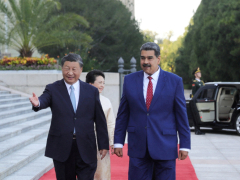

Hours before United States special forces abducted Venezuelan President Nicolas Maduro last Saturday, Maduro met with China’s special envoy to the Latin American country to reaffirm their nations’ “strategic relationship”.
Now the decades-long relationship is in question, as is the future of billions of dollars of Chinese investment in the country. At the same time, the US has handed China a new opportunity to assert its dominance in its own back yard, including on its claim to self-governing Taiwan, say analysts.
Recommended Stories
list of 4 items
- list 1 of 4China bans export of dual-use items to Japan amid tensions over Taiwan
- list 2 of 4Which teams are in the AFCON 2025 quarterfinals, and what’s the schedule?
- list 3 of 4Israel’s continued attacks on Lebanon could derail Hezbollah disarmament
- list 4 of 4Survivors recount RSF gang rape in Sudan; infants among victims
end of list
Under the 19th-century Monroe Doctrine, recently revived by US President Donald Trump, the Western Hemisphere falls under the US sphere of influence – and the US only.
Trump invoked the doctrine in his latest national security strategy published late last year. Originally intended to keep Europe out of the Western Hemisphere, Trump’s version emphasises the need to counter China’s presence there.
The “Trump Corollary” to the Monroe Doctrine states the US wants a Western Hemisphere that “remains free of hostile foreign incursion or ownership of key assets, and that supports critical supply chains” in an oblique reference to China.
ABC News and CNN on Tuesday reported that the Trump administration was demanding that Venezuela cut ties with China, Iran, Russia and Cuba before it would be allowed to resume oil production.
The White House declined to confirm or deny the reports, which cited unnamed sources.
Trump has previously taken issue with Chinese investment in the region and claimed, incorrectly, during his inauguration speech last year that China was in control of the Panama Canal.
Since US forces captured Maduro last week, Trump has also revived claims that the US should “acquire” Greenland, an autonomous Danish territory, to protect US national security.
He claimed this week that the Arctic island was inundated with “Russian and Chinese ships,” although there is no evidence to support his claim.
“China is likely to read this as confirmation that the US is explicitly comfortable with hemispheric spheres of influence,” said Simona Grano, head of research on China-Taiwan relations at the University of Zurich’s Institute for Asian and Oriental Studies.
China immediately condemned Maduro’s abduction by US special forces as a “clear violation of international law” and urged Washington to “stop toppling the government of Venezuela”.
But the return of these spheres “cuts both ways for Beijing,” said Grano.
“On the one hand, it underscores the vulnerability of China’s investments and partnerships in Latin America; on the other, it may reinforce Chinese perceptions that Washington would find it harder to credibly oppose similar logic in East Asia, even if the Taiwan case is far more sensitive and escalatory,” she told Al Jazeera.
China has pledged to annex Taiwan by peace or by force if necessary and regards Taipei’s Democratic Progressive Party, which heads the democratically elected government, as separatists.
Diplomatically isolated Taiwan is only recognised by 11 countries and the Holy See, but it has unofficial backing from the US, which has pledged to help Taipei defend itself under the 1979 Taiwan Relations Act and the 1982 Six Assurances.
While Beijing regards Taiwan as an “internal” matter, Trump’s policy regarding “spheres of influence” could offer it another way to discuss Taiwan on the world stage, said Lev Nachman, a political scientist and an assistant professor at National Taiwan University.
“I do think that America has created more global precedent for large powers to take action against other states beyond their jurisdiction,” Nachman told Al Jazeera.
Though China is unlikely to act militarily against Taiwan in the near future, “it will now have an easier time justifying military action if and when the day comes,” Nachman said.
Taiwan is not the only place Beijing may consider to fall under its “sphere of influence”. China claims much of the South China Sea and has ongoing territorial disputes there with Vietnam, the Philippines, Brunei, Malaysia and Taipei, while it also claims the Japanese-administered Senkaku Islands in the East China Sea.
Disputes between China and India on its eastern border have ended in deadly clashes, including a 1962 border war and more