
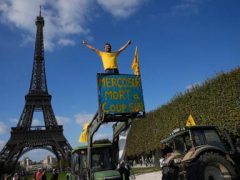

BRUSSELS — France is throwing up a last-minute obstacle to a massive trans-Atlantic trade deal between the 27-country European Union and the five South American nations of the Mercosur bloc that’s taken a quarter-century to negotiate.
Angry European farmers fearing new competition from the EU-Mercosur pact are marching on Brussels, and European negotiators who thought they would finally wrap up the deal this year are facing a tough week.
The deal between the EU and the five Mercosur countries — Brazil, Argentina, Uruguay, Paraguay and Bolivia — would progressively remove duties on almost all goods traded between the two blocs over the next 15 years. Provided it is ratified by both blocs, the accord would cover a market of 780 million people and a quarter of the globe’s gross domestic product.
Negotiators agreed on the EU-Mercosur deal a year ago, but it now must be approved by all 27 EU countries, as well as the European Parliament.
Both the European Commission President Ursula von der Leyen and European Council President António Costa are scheduled to sign the deal in Brazil on Dec. 20 — if aggrieved farmers marching on Brussels and vocal opposition from key EU nations don’t derail their plans.
In the run-up to what many expected to be the final stretch, French Prime Minister Sébastien Lecornu said on Sunday that the current EU-Mercosur deal was “unacceptable,” and that conditions for a vote of EU heads of state and government on Thursday “have not been met.” He requested a delay, which would push the vote to 2026 or beyond.
While commending recent measures taken by the European Commission to both protect farmers and increase inspections of agricultural imports for food safety violations like pesticides banned in the EU, Lecornu said that France has not been fully placated.
“It is clear in this context that the conditions are not in place for any vote by the EU Council on authorizing the signing of the agreement,” he said.
Poland, Austria, the Netherlands and France are concerned that Mercosur exporters could undercut EU products made with stronger labor and sanitary regulations like pesticide restrictions, said Alicia Gracia-Herrero, a senior fellow at the Brussels-based Bruegel Institute. France has failed to get Mercosur to agree to “mirror” those regulations.
She said that the deal reflects limits on the EU’s geopolitical strength, political unity and capability.
“If we cannot get this done even with (U.S. President Donald) Trump’s pressure, what can you expect from the EU?” she said. “I hope France cannot fully torpedo this because the EU cannot afford a further delay in Mercosur if it