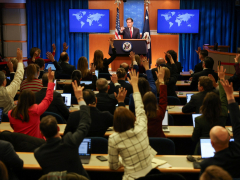

Top United States diplomat Marco Rubio has laid out the foreign policy priorities under President Donald Trump, saying that the administration is focused on advancing Washington’s interests across the world.
In a two-hour briefing to reporters on Friday, the US secretary of state reiterated Trump’s hard line against Venezuela and defended cuts to foreign aid programmes.
Recommended Stories
list of 3 items
- list 1 of 3Israel bombs Gaza wedding as mediators hold ceasefire talks in US
- list 2 of 3Rubio says ‘progress but ways to go’ in efforts to end Russia-Ukraine war
- list 3 of 3‘War on terror’ defence of Trump boat strikes doesn’t hold water: Experts
end of list
Rubio, the son of Cuban immigrants, also expressed outrage against “mass migration” into the US, echoing Trump’s stance.
In addition to his diplomatic duties, Rubio also serves as the White House national security adviser and the chief of the now-gutted US Agency for International Development (USAID).
Here are five key takeaways from the state secretary’s wide-ranging media briefing:
Maduro cannot be trusted
Rubio suggested that further talks with Venezuela would be futile because President Nicolas Maduro cannot be trusted to live up to his commitments.
“He’s never kept any of the deals he’s made in the past, which makes it difficult to consider making one in the future,” Rubio said of Maduro.
The top diplomat kept hammering accusations that Maduro has used the Venezuelan government to lead a campaign of narcotics trafficking and “terrorism”.
Trump has made similar allegations, accusing the Venezuelan president of masterminding a flood of drugs and criminals into the US.
He has also portrayed Maduro as a cartel leader, in charge of groups like the Venezuelan gang Tren de Aragua. Those assertions, however, have been contradicted by the US intelligence community, which found no evidence that Maduro controls the gang.
On Friday, Rubio said that the US is working with governments in the Western Hemisphere to ensure stability in the Caribbean region. But Venezuela, he underscored, is an outlier.
“There’s one place that doesn’t cooperate, and it’s the illegitimate regime in Venezuela. Not only do they not cooperate with us, they openly cooperate with terrorist and criminal elements,” he said.
“For example, they invite Hezbollah and Iran to operate from their territory.”
Trump’s allies have accused Maduro of forging ties with Hezbollah, but the US has not provided evidence that the Lebanese armed group, which was weakened by last year’s war with Israel, is operating in the South American country.
Rubio’s comments come as the US continues to amass troops and military assets around Venezuela, raising speculation about plans to topple Maduro by force.
Trump has also announced an oil blockade on Caracas as he and his top aides continue to falsely claim that Venezuela’s oil belongs to the US.
Rubio was asked on Friday how he would square Trump’s self-image as a peacemaker with the escalating military threats to Venezuela.
“We reserve the right – and have the right – to utilise every element of national power to defend the national interest of the United States,” Rubio said. “And no one can dispute that. Every country in the world reserves the same option. We just simply have more power than some of them.”
Ukraine ‘not our war’
The ongoing war in Ukraine, which has been raging since Russia’s full-scale invasion in February 2022, was also a key topic in Friday’s news conference.
Rubio explained that the Trump administration is trying to gauge what Russia and Ukraine are able to accept to help reach a peace deal, but he emphasised that the war is not a top priority for Washington.
“It’s not our war. It’s a war on another continent,” he said.
However, Rubio insisted that only the US can bring about a peace agreement in Ukraine.
“What we’re trying to figure out here is, what can Ukraine live with and what can Russia live with? Sort of identify what both sides’ positions are, and see if we can sort of drive them towards each other to some agreement,” Rubio said.
“If you were to ask [for] prioritisation, I would argue that something in our hemisphere for our national interest is more important than something in another continent,” he said. “But it doesn’t make Ukraine and Russia unimportant. We care about it. That’s why we’re involved in it.”
While campaigning for re-election in 2024, Trump pledged to end Russia’s war in Ukraine within 24 hours of reclaiming the presidency.
He has since had to walk back those remarks, but the Republican leader has maintained an active role in peace negotiations, even hosting Russian President Vladimir Putin for a meeting in Alaska in August.
Trump has lobbied for the