
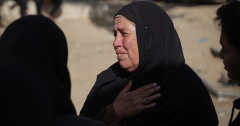

Gaza City, Gaza Strip – With exhausted steps and eyes filled with tears, Hanaa al-Mabhuh moves between the hall displaying photographs of bodies and the morgue at al-Shifa Hospital in a grim search for any trace of her missing son.
The 56-year-old mother wipes away tears with the back of her hand and stares at the decomposed faces on the screen, torn between the desire to find out what happened to her youngest child, while at the same time fearing he might be among the dead handed over by Israel under a US-brokered ceasefire deal.
Recommended Stories
list of 4 items
- list 1 of 4Over 100 artists for Palestine back UN’s Albanese after resignation calls
- list 2 of 4Trump and Netanyahu align on Iran pressure but split on endgame
- list 3 of 4‘De-facto annexation’: Palestinians slam Israel’s West Bank land plans
- list 4 of 4Thousands of Western nationals fought Israel’s war on Gaza: What to know
end of list
Thousands of Palestinians from Gaza have been seeking information on loved ones who went missing since the war began after the deadly October 7, 2023 raid by Hamas.
Driven by her need for closure, Hanaa returns to scan the images on the screens one more time.
“This boy is a piece of me,” Hanaa tells Al Jazeera, referring to 18-year-old Omar, who disappeared along with one of his cousins, Alaa, when they went to inspect the ruins of their home in Jabaliya refugee camp in northern Gaza last June. Omar, a high school student, was the youngest among his seven siblings.
“Every child is precious to his family, but my son is a part of me,” she adds, tears streaming down her cheeks as she walks toward the morgue.
The family contacted the International Committee of the Red Cross (ICRC) and several human rights organisations to try to find out what happened to Omar and his cousin, but to no avail.
Hanaa says the wait has been heartbreaking.
“We do not know whether they are prisoners, or whether they [the Israelis] killed them and took their bodies or detained their bodies along with those bodies they release in batches.”
“We are running as if in a mirage and we do not know anything,” says Hanaa, falling silent as if trying to catch her breath.

Endless search
Since Israel began returning Palestinian bodies to Gaza through the Karem Abu Salem (Kerem Shalom) crossing, Hanaa has become one of hundreds of family members moving between hospitals and reception points seeking any clues to the fate of their loved ones.
The latest batch of bodies came on February 4. Gaza’s Health Ministry said 54 bodies and 66 boxes containing human remains, released by Israel via the ICRC, had been received.
The remains arrived at al-Shifa Hospital in Gaza City, where medical and technical teams began initial examinations and documentation before presenting them to families for possible identification.
Human rights organisations say handovers occur through the Red Cross in accordance with international rules, but these procedures do not always include detailed documentation or the circumstances of death, increasing the burden on Gaza authorities to classify bodies and attempt identification amid limited capacity to conduct DNA testing.
Since the latest handover, Hanaa has gone to the hospital several times to review lists and photographs of the bodies.
“I have not left any place without going to it. I even went to Khan Younis in the south of the Strip to check the photos,” she says.
The bodies were returned under the United States-brokered October 2025 truce agreement between Israel and Hamas, which stipulated that the remains of 15 Palestinians would be exchanged for the bodies of every Israeli held in Gaza.
As of last month, Israeli authorities continue to hold the bodies of more than 770 Palestinians in what is known as the “cemeteries of numbers and morgues“, according to the National Campaign for the Recovery of Martyrs’ Bodies and Disclosing the Fate of the Missing.
Hanaa’s suffering does not stop at reviewing Palestinian bodies. She also checks the lists of prisoners released by Israel from time to time, contacting the ICRC to try to confirm if her son’s name appears.
“By God, the Red Cross has memorised me and my voice from how much I call and ask. They tell me: ‘Sister, aren’t you the one who called last time?’ I tell him: ‘Yes, my brother. Forgive me, it is not in my hands.’ He sympathises with me,” she says.
Despite the gruelling effort, there is still no decisive answer about her son’s fate.
“My heart as a mother wishes that my son is alive. But I prepare myself for the worst possibilities, and even this psychological preparation has brought no result,” Hanaa says.
‘Why do they leave us lost?’
Hanaa says the hardest part is not only the loss, but the state of confusion and disorientation she lives through, along with hundreds of members of other families still searching for their relatives.
“Why do they leave us lost like this? We don’t know where they went or what their fate is,” she says.
Another grim aspect is witnessing the “pitiful condition” in whi