
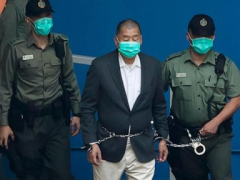

HONG KONG — A Hong Kong court heard arguments Monday about the sentencing of democracy advocate and onetime-media magnate Jimmy Lai, whose conviction under a national security law could land him in prison for the rest of his life.
Lai founded the now-defunct Apple Daily newspaper and was an outspoken critic of China’s ruling Communist Party. He was arrested in 2020 under the law imposed by Beijing following massive anti-government protests that rocked Hong Kong the year before.
In December, he was found guilty of conspiring with others to collude with foreign forces and conspiracy to publish seditious articles.
His conviction raised concerns about the curtailing of press freedom in the former British colony, which returned to Chinese rule in 1997.
His case could also test Beijing’s diplomatic ties. The verdict drew criticism from foreign governments, including the U.S. and Britain. After the verdict, U.S. President Donald Trump, who had raised Lai’s case with China, said he felt “so badly.”
Lai, alongside other co-defendants, appeared in court for the four-day mitigation hearings. The maximum penalty is life imprisonment. Sentencing will come later.
Lai’s lawyer Robert Pang said his client’s health, age and solitary confinement would make his sentence “more burdensome” compared to that of the general prison population. Lai is 78, so the impact of a lengthy prison sentence will be greater, Pang argued.
“Every day he spends in prison,” Pang said, “brings him closer to the end of his life.”
When Lai entered the courtroom, he pressed his palms together, an apparent gesture to express gratitude, and smiled at those sitting in the gallery. The media tycoon appeared to be in good spirits and greeted a convicted Apple Daily editor who was also in the dock.
In August, his lawyers told the court that he suffered from heart palpitations. Hong Kong’s government said no abnormalities were found in a subsequent medical exam.
Prosecutor Anthony Chau said Lai’s health was stable. Chau said Lai had lost just 0.8 kg (about 1.8 pounds) over five years of detention, weighing 79.2 kg (about 175 pounds) when it was last measured this month. Lai is still considered obese as an Asian adult, Chau said. The obesity comment drew chuckles from some people sitting in the public gallery, and Lai also smiled.
But Pang argued that his client no longer lived up to his nickname of “Fatty Lai,” in contrast to images in videos filmed before detention and previously shown to the court.
Esther Toh, one of the three government-vetted judges, rejected estimating weight by relying on human eyes, saying people may look fatter on camera. Pang also said Lai’s weight once dropped 11 kg (24 pounds) within a year, though the court heard he later regained some of the weight.
The lawyer said Lai suffers health issues like hypertension, diabetes and a blocked vein in one eye.
Pang argued