
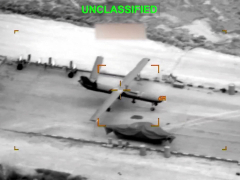

The long-running confrontation between the US and Iran entered a new phase on Saturday when joint US-Israeli air strikes targeted Iran, marking a moment of open military hostilities.
As US President Donald Trump signals that operations could last four to five weeks, we look at whether Washington can sustain a new war in the Middle East, and what it might ultimately cost.
What is Operation Epic Fury?
On February 28, Trump confirmed in an eight-minute video posted on Truth Social that the US had taken part in what he described as a “major combat operation” inside Iran.
The Pentagon later said the mission was named Operation Epic Fury.
Trump said the objective was to “ensure that Iran does not obtain a nuclear weapon”.
“We’re going to destroy their missiles and raze their missile industry to the ground. It will be totally obliterated,” he added.
The US military said that it had struck more than 1,250 targets in Iran since operations started on Saturday. In a separate statement, the US military’s Central Command (CENTCOM) said it had struck and destroyed 11 Iranian ships.
The operation reportedly involved air strikes, sea-launched cruise missiles and coordinated attacks on nuclear-related facilities, as well as on senior figures linked to Iran’s defence establishment.
Iran’s Supreme Leader, Ayatollah Ali Khamenei, who had led the country since 1989, was killed when his Tehran compound was struck and heavily damaged in the first wave of US-Israeli strikes.
On Monday, Trump promised to pursue the war for as long as necessary, suggesting it could extend over several weeks. As of Monday, the Iranian Red Crescent said that 555 people had been killed across 130 locations in Iran.
How much has the US already spent in Israel and the Middle East since 2023?
According to Brown University’s 2025 Costs of War report, since October 7, 2023, the US has provided Israel with some $21.7bn in military aid.
In addition to that, the American taxpayer has funded US operations in support of Israel in Yemen, Iran and the wider Middle East at a cost of $9.65bn to $12.07bn.
That brings total US spending connected to the conflict to between $31.35bn and $33.77bn, and counting.
Which weapons systems are being used in the Iran war?
According to CENTCOM, Operation Epic Fury has involved more than 20 weapons systems across air, sea, land and missile defence forces.
CENTCOM says more than 1,000 targets inside Iran have been struck, using more than 20 different systems across the air, sea and land, as well as the missile defence force.
“The focus of the United States and Israelis now is to blunt or degrade – as quickly as they can – the offensive capabilities of the Iranians to keep wreaking havoc. You want to stop these attacks, or at least diminish them as much as you can,” Kevin Donegan, a former CENTCOM operations director, told Al Jazeera.
Some of the weapons systems include:
Air Power:
The campaign has relied heavily on US air assets, including:
- B-1 bombers
- B-2 stealth bombers: used to strike key nuclear and military infrastructure
- F-35 Lightning II & F-22 Raptor: advanced stealth fighters
- F-15 fighter jets: extensively used; three were lost in an incident over Kuwait on March 1
- F-16 Fighting Falcon, F/A-18 Super Hornet, and A-10 attacker jets: all confirmed for strike and support roles
- EA-18G Growler: used for electronic attack and suppressing enemy air defences
- Airborne early warning and control aircraft (AWACS): providing command, control and battle-space management.
Drones and long-range strike systems
Unmanned systems and rocket artillery are also part of the operation:
- LUCAS drones: This operation marks the first combat use of these “low-cost unmanned combat attack system” one-way drones, which were reverse-engineered from Iranian designs
- MQ-9 Reaper drones: active in surveillance and precision strike roles
- M-142 High Mobility Artillery Rocket Systems (HIMARS): ground-based rocket artillery
- Tomahawk Cruise Missiles: launched from naval assets.
Missile defence systems
- Patriot interceptor missile systems and THAAD (Terminal High Altitude Area Defense): used to intercept Iranian ballistic missiles and drones
- Counter-drone systems.

Naval power projection
- Two carrier strike groups, led by the USS Gerald R Ford and USS Abraham Lincoln: providing massive sea-based power
- P-8 Poseidon: conducting maritime patrol and reconnaissance
- Cargo and tankers: C-17 Globemaster, C-130 Hercules, and various aerial refuelling tankers are maintaining the logistics flow.