

At the World Economic Forum in Davos, Switzerland, last month, Jared Kushner, billionaire real estate scion and son-in-law to United States President Donald Trump, presented his vision of a “New Gaza”: glittering skyscrapers, waterfront tourism and a logistical corridor connecting a demilitarised enclave to the world.
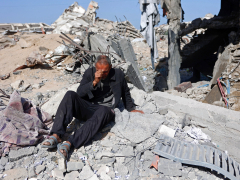
But 3,000km (1,864 miles) away, on the bombed and dusty lands of the Gaza Strip, not a single brick has been laid as the distressing reality of the Palestinian territory is now measured not in new buildings but in tonnes of debris – specifically, 61 million tonnes of it.
After a fragile “ceasefire” was reached between Israel and Hamas in October, Israel’s air strikes may have let up, but the killings have not stopped, signalling a new, quieter war.
Meanwhile, there is no clarity on the potential entry of cement and steel rods – crucial construction materials whose entry Israel has blocked.

According to the United Nations, 92 percent of Gaza has been destroyed during Israel’s more than two-year genocidal war, and the cost of its rebuilding is estimated at $70bn.
Yet analysts and urban planners warned that Gaza’s reconstruction is being designed not to restore Palestinian life but to “re-engineer” it – turning the basic human right of shelter into a tool of political extortion and alleged demographic change.
“Reconstruction is not the ‘day after’ the war; it is the continuation of war by bureaucratic and economic means,” Ihab Jabareen, a researcher specialising in Israeli affairs, told Al Jazeera.
‘Cement faucet’
Jabareen argued that for the Israeli security establishment, reconstruction is the ultimate bargaining chip, allowing Israel to move from a strategy of direct military occupation to one of “sovereignty by flow”.
“Whoever owns the oxygen of Gaza – the cement faucet – owns its political and security shape,” he said, adding that Israel aims to create a unique system of “control without responsibility” in which it holds veto power over how daily life in Gaza is conducted without the legal obligations of an occupier.
This system relies on turning the potential entry of construction materials and aid into a political decision through what Jabareen called three layers of extortion:
- Security extortion: linking the flow of materials to “long-term surveillance”, creating a permanent dependency under which Gaza is rebuilt to a size that can be easily “switched off” at any moment.
- Political extortion: using reconstruction to determine who governs. “Whoever distributes the cement, distributes the legitimacy,” Jabareen said, suggesting that Israel will allow reconstruction only under a “technocratic” proxy administration that fits its security needs.
- Pacification extortion: turning the hope of basic survival – a roof over one’s head – into a “reward” for silence, rather than a right.
‘Phoenix Plan’
Before these political battles can even be fought, Gaza literally remains buried under the rubble of two years of Israeli bombardments. A United Nations Development Programme report released in November painted a grim picture: The debris generated by the war creates an “unprecedented obstacle” that could take seven years to clear – and that is only under “ideal conditions”.
“Gaza stands as one of the most devastated places on earth,” the report said.
Faced with this reality, Palestinian experts rejected the top-down models for reconstruction proposed in Davos. Abdel Rahman Kitana, professor of architecture at Birzeit University in the occupied West Bank, pointed to the “Phoenix Plan”, a framework developed by the Union of Gaza Strip Municipalities, as a viable local alternative.
“Reconstruction is not just about restoring what was destroyed. It is about reshaping life,” Kitana told Al Jazeera Arabic as he warned against disconnected solutions for Gaza. He instead advocated for an “integrated approach” rooted in the Phoenix Plan, under which rubble is not treated as waste but as a resource that could be recycled for land reclamation.
Kitana insisted that any successful plan