

I work for the American Friends Service Committee (AFSC), a Quaker organisation that has been present in Gaza for more than 77 years. AFSC began its work in 1948 when the United Nations asked it to organise relief efforts for Palestinian refugees who had been expelled from their land by Zionist forces.
For two years, AFSC’s Gaza staff helped set up and run 10 refugee camps in al-Faluja, Bureij, Deir el-Balah, Gaza City, Jabalia, Maghazi, Nuseirat, Khan Younis and Rafah. They worked to provide food, shelter and sanitation as well as setting up educational programmes for children.
In the decades that followed, AFSC’s programmes have provided support for agricultural development, kindergartens, midwife training, humanitarian aid and trauma healing. Since the start of Israel’s genocide in 2023, AFSC staff members in Gaza have provided more than a million meals, food parcels, fresh vegetables, hygiene kits and other essential supplies.
Now, for the first time since 1948, AFSC along with dozens of other international organisations is threatened with a ban from the Israeli government that puts lifesaving humanitarian work in jeopardy. This would have a devastating effect on the people of Gaza. And it cannot come at a worse time.
A continuing genocide
The mass killing in Gaza has not stopped. Despite a ceasefire, Israeli forces are carrying out ongoing raids, air strikes and large-scale demolitions across Gaza. Since the ceasefire began on October 10, these attacks have killed more than 420 Palestinians and injured more than 1,150.
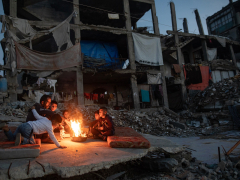
And it is not just the bombs. Floods in Gaza have destroyed tens of thousands of tents while badly damaged homes continue to collapse on residents. The absence of medicines and proper healthcare is killing people as well; about 600 kidney disease patients have died as a result of lack of treatment.
Meanwhile, Israel continues to prevent temporary shelters, medicines and other desperately needed supplies from entering.
These actions have reinforced a longstanding Israeli policy aimed at depopulating Gaza and annexing the land. Israel’s prohibitively restrictive new registration policies and efforts to prohibit or limit international aid are part of this effort. Silencing independent humanitarian voices and dismantling humanitarian infrastructure serve to create conditions on the ground that make life in Gaza impossible. Gaza cannot recover or thrive without comprehensive reconstruction that restores its health system, education sector and critical infrastructure.
Just two weeks before the ceasefire began, an Israeli air strike struck my family home, killing nine of my immediate relatives, including two of my siblings, their spouses and their children.
When I spoke to surviving family members shortly afterwards, they told me the “responsibility is light now” – a phrase they used to express that the number of people to care for is less now.
Since that phone call, I have not stopped thinking about what responsibility truly means. For me, it did not become lighter. It grew heavier. Nine children were left orphaned. With each life taken from my family, the weight of responsibility only increased – the responsibility to remember, to care for those left behind and to bear witness to what has been done.