
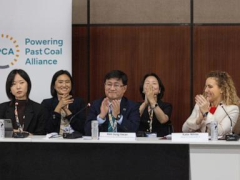

SEOUL, South Korea — South Korea is promising to shrink its reliance on coal power as part of its pledge to reduce carbon emissions that contribute to climate change, but that ambition is at odds with the Trump administration’s push for more U.S. natural gas exports.
At recent United Nations climate talks, South Korea’s new Ministry of Climate, Energy and Environment announced plans to retire most of the country’s coal-fired power plants by 2040 and to at least halve its carbon emissions by 2035.
Experts say this shows that South Korea, a major coal importer with one of the world’s largest fleets of coal plants, wants to speed up its renewable energy transition, which lags behind its neighbors and global averages.
But as part of trade deals with President Donald Trump, Seoul is raising imports of U.S. liquefied natural gas, or LNG. Climate activists contend such plans may conflict with the country’s pledges to help curb climate change and could lock South Korea into a fossil fuel-dependent future.
Talks are underway for South Korea to invest $350 billion in U.S. projects and purchase up to $100 billion worth of U.S. energy products, including LNG, a natural gas cooled to liquid form for easy storage and travel. It burns cleaner than coal, but still causes planet-warming emissions, especially of methane.
South Korea’s overall LNG imports may not increase if it offsets purchases of more U.S. natural gas by reducing imports from other sources such as Australia and the Middle East.
Still, it’s unclear how South Korea will “manage and consolidate all this somehow contradictory planning regarding its energy sector,” said Michelle Kim, an energy specialist for the U.S.-based Institute for Energy Economics and Financial Analysis.
South Korea’s liberal President Lee Jae Myung, who won a snap election in June, campaigned for stronger climate commitments. They had softened under his conservative predecessor Yoon Suk Yeol, who was ousted after a short-lived martial law declaration.
“As the global temperature rises, we all need to responsibly take climate action and Korea will have a stronger sense of responsibility in tackling the climate crisis,” Kim Sung-hwan, the inaugural Minister of Climate, Energy and Environment, said in an interview with The Associated Press.
South Korea’s goal to cut carbon emissions by 53% to 61% of its 2018 level, fell short of climate activists’ expectations. Business lobbies representing major manufacturers had proposed a 48% emissions reduction target.
“This range presents an effort by the government to accommodate two very different ways of thinking about the economic and climate future of the nation,” said Joojin Kim of the Seoul-based advocacy group, Solutions for Our Climate.
The South Korean government made the ambitious commitment to increase its clean energy use even after Trump’s sweeping ‘America First’ tariffs spurred energy negotiations between Seoul and Washington.
As part of its broader efforts to avoid higher tariffs, South Korea offered to import more LNG from the U.S., but the final trade deal has not been announced.
The agreement still under negotiation could last between three to 10 years, according to industry analysis and U.S. federal documents. Depending on the deal’s duration, South Korea may import between 3 million to 9 million tons of American LNG a year.
LNG made up almost a fifth of South Kore