
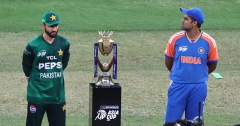

When India and Pakistan meet in the T20 World Cup on Sunday, the match will not just be significant for its on-field cricket action but also the political climate that has shrouded the encounter and the tournament itself.
The South Asian nations share a decades-old history of wars and hostile relations. The most recent encounter came in May 2025, when the nuclear-armed neighbours were engaged in a four-day cross-border conflict.
Recommended Stories
list of 4 items
- list 1 of 4India now sets the terms of global cricket
- list 2 of 4ICC Men’s T20 Cricket World Cup 2026 explained in maps and charts
- list 3 of 4Why is Pakistan backing Bangladesh in its T20 World Cup row with India?
- list 4 of 4All to know about the ICC T20 World Cup 2026 stadiums
end of list
This 78-year-old bitter history has fuelled the sporting rivalry, which has – at times – led to tournament boycotts, cancelled matches and ground invasions.
Players from both teams have often been involved in heated encounters on the field, but have also publicly shared lighter moments off it.
However, the lingering hostility of the last conflict has made a severe and long-term impact on cricket, which is the most widely followed sport in South Asia.
We look back at the deteriorating cricket relations between India and Pakistan since the May conflict and the on-field events steeped in politics:
September 14 – No handshake row
The controversy began when India’s Suryakumar Yadav opted out of the customary pre-toss captains’ handshake with Pakistan’s Salman Ali Agha, prompting fans to wonder if politics were at play.
The doubts were cleared at the end of the match when, after hitting the winning runs, Yadav and his batting partner Shivam Dube walked off the field without approaching the Pakistani captain and team for the traditional post-match handshakes.
Pakistan’s players trudged off in a group and waited for the Indian squad, but the Indian contingent only shook hands with each other before walking into their dressing room and shutting the door as the waiting Pakistan players looked on.
Later, Yadav confirmed that his team had planned to not shake hands with Pakistani players all along, linking it to the April 22 attack in Indian-administered Kashmir that preceded the May conflict.
“A few things in life are above sportsman’s spirit,” the 35-year-old said.

September 17 – Pakistan refuse to take the field against UAE
The fallout of the handshake row carried over into Pakistan’s next group game in the Asia Cup, when they refused to take the field against the UAE in protest against match referee Andy Pycroft.
Pakistan insisted that Pycroft be removed from their fixture as he was the key official in the India match and helped carry out India’s request that the captains not shake hands at the toss.
“Andy Pycroft had barred the captains of India and Pakistan from shaking hands during their match,” the Pakistan Cricket Board (PCB) said in a statement.
The Pakistan-UAE match was delayed by an hour as negotiations took place behind closed doors, and Pycroft apologised for the “miscommunication”.

September 21 – Players exchange heated words, make references to conflict
When the teams met for the second time in the Asia Cup, players from both sides were seen exchanging verbal blows in the middle of the pitch.
Pakistan’s Haris Rauf had a go at India’s batter Abhishek Sharma, who later said his match-winning innings of 74 runs was a response to Pakistani players.
“The way they were coming at us without any reason, I didn’t like it at all,” Sharma said after the match.
Rauf was also seen making gestures towards the Indian supporters while fielding on the boundary. He held up his hands to indicate the numbers six and zero, a reference to Pakistan’s claim of downing six Indian jets during the May conflict.
The fast bowler also made gestures indicating an aircraft nosediving into the ground.
Following the match, the Board of Control for Cricket in India (BCCI) lodged a complaint with the International Cricket Council (ICC) against Rauf and Pakistani batter Sahibzada Farhan, who marked his half-century with a mock gun celebration.
Pakistan, too, lodged a complaint against India’s captain Yadav for using his post-match press comments to mention the Indian missile attacks in Pakistan.

September 28 – India refuse to receive trophy from Pakistani official
The controversial tournament peaked in the final when India, who beat Pakistan by five wickets, refused to accept the Asia Cup trophy because it was presented by Mohsin Naqvi, who is the Asian Cricket Council (ACC) president as well as the chairman of the PCB.
Naqvi is also Pakistan’s federal interior minister.
“We have decided not to take the Asia Cup trophy from the ACC chairman, who happens to be one of the main [political] leaders of Pakistan,” Devajit Saikia, the chairman of the Board of Control for Cricket in India (BCCI), said.
The final award presentation was delayed by more than an hour due to India’s refusal and Naqvi’s insistence on presenting the trophy. The Indian team celebrated by pretending to hold a trophy.
India’s captain Yadav added it was the team’s decision to refuse the trophy and “no one told us to do it”.
