
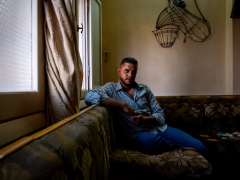

Ziad Mahmoud al-Amayiri sat with photographs of his 10 lost family members laid out in front of him.
“There are two options: either the government gives me justice, or I take justice myself.”
Al-Amayiri’s threat is directed at one man: Fadi Saqr.
Saqr was a commander of the National Defence Forces (NDF), a militia loyal to Bashar al-Assad that was accused of atrocities like the 2013 Tadamon massacre, where, according to local Syrian officials, activists and leaked videos, dozens of people were led to a pit and shot.
However, Saqr denies any links to what happened in Tadamon. He told The New York Times that he was not the NDF’s leader at the time.
But al-Amayiri insists Saqr should be behind bars for the disappearance of his loved ones, who he says were arrested by NDF fighters in 2013.
Instead, Saqr is walking free.
Hassan Soufan, a member of the government-appointed Committee for Civil Peace, says Saqr was “granted safe passage” by Syria’s new leadership “at the beginning of the liberation”.
Soufan said Saqr’s release was part of a strategy to calm tensions because of his links to Alawite groups in the region.

“No one can deny that this safe passage contributed to averting bloodshed,” said Soufan.
But that was not enough to satisfy many Syrians, especially in Tadamon, where residents demanded that Saqr be tried in court.
“How was the government able to forgive Fadi Saqr with the blood of our families?” said al-Amayiri, speaking of the 10 loved ones he has lost.
“I don’t think they will be able to hold him accountable after that.”
Syria’s fragile peace
A year on since the fall of Bashar al-Assad, Syria’s new leadership is dealing with the very real danger of people feeling frustrated by justice efforts being delayed or denied.
After taking power, interim President Ahmed al-Sharaa said he would prioritise “achieving civil peace” and “prosecuting criminals who spilt Syrian blood … through genuine transitional justice”.
But the last year has been marked by sectarian fighting – and there has been a marked rise in so-called revenge killings.
As of November 2025, the Syrian Observatory for Human Rights (SOHR) reported that 1,301 people had died in what it described as “retaliatory actions” since the fall of the Assad regime in December 2024.
These statistics do not include the people killed during the violent clashes on either the Syrian coast in March or in Suwayda in July.

The coastal massacres alone resulted in the death of 1,400 people, mainly civilians, according to a United Nations report.
The clashes in Suwayda, triggered by fighting between Druze and Bedouin communities, killed hundreds, the majority of them Druze.
In his first interview with an English-language outlet, Abdel Basit Abdel Latif, head of the National Commission for Transitional Justice, acknowledged the risks of stalled justice.
“It is certain that any Syrian citizen will feel that if the transitional justice process does not start properly, they will resort to their own ways, which is something we do not wish for,” Abdel Latif said.
Ibrahim al-Assil from the Atlantic Council says it is an example of a conundrum often seen in transitional justice: pursuing justice versus keeping the peace.
“Which one comes first? It’s very important to realise that they do need to work hand in hand, but things are never ideal.”

Transitional justice in Syria
The government has set up two bodies to oversee transitional justice.
One, headed by Abdel Latif, tackles transitional justice more broadly, addressing violations committed by the former regime.
The other is focused on investigating the estimated 300,000 Syrians considered missing and widely believed to have disappeared into al-Assad’s notorious prison system and buried in mass graves.

While the scale of the missing is often reported as more than 100,000 people, the head of the National Commission on Missing Persons believes it is approximately 300,000.
Ever since the fall, there have been concerns that this number is rising, with UN Human Rights spokesperson Thameen al-Kheetan saying they “continue to receive worrying reports about dozens of abductions and enforced disappearances”.
Both national committees have met international experts to draw lessons from other transitional justice processes.
But Danny al-Baaj, vice president for advocacy and public relations at the Syrian Forum, believes “we’re far behind any real progress”.
“A framework is still missing. A special law on transitional justice is still missing,” he said.
The families of the hundreds of thousands of forcibly disappeared Syrians are also demanding answers.
Wafa Ali Mustafa is a Syrian activist whose father, Ali Mustafa, was arrested in the capital, Damascus, 12 years ago.
“Families of the detainees are not going on the streets every day saying that now you have to dig mass graves,” she said.
“They’re saying at least communicate with us, at least let us know what you are doing.”
The head of the National Commission on Missing Persons, Mohammad Reda Jalkhi, explained that Syria needs a huge amount of resources.
