
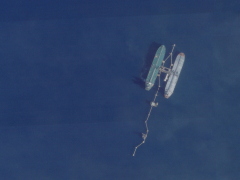

On Wednesday, the United States hijacked an oil tanker off the coast of Venezuela – a new move in the ongoing aggression against the South American nation by the administration of US President Donald Trump.
Over recent months, the US has gone about wantonly blowing up small boats in the Caribbean Sea along with their passengers, whom Trump has telepathically divined to be drug traffickers.
Exercising his passion for ridiculous overstatement, Trump proclaimed on Wednesday that the seized vessel was a “large tanker, very large, largest one ever seized, actually”.
When asked at a news conference about the ship’s altered destination, Trump advised reporters to “get a helicopter and follow the tanker” – although folks might reasonably be wary of taking to the skies around Venezuela given Trump’s unilateral decree in November that the country’s airspace was “closed in its entirety”.
Of course, the airspace closure hasn’t managed to interfere with continuing US deportation flights to Venezuela.
Regarding the fate of the tanker’s valuable contents, Trump remarked, “I assume we’re going to keep the oil.”
To be sure, this comment doesn’t do much to shore up the US claim that it’s not after Venezuela’s vast oil reserves at all, but is simply trying to guard the hemisphere against nefarious Venezuelan narco-terrorists endeavouring to flood the homeland with fentanyl and other deadly products.
As per Trumpian fantasy, the ringleader of the narco-terror operation is none other than Venezuelan President Nicolas Maduro himself.
Never mind that Venezuela has approximately zero to do with drugs entering the US and doesn’t even produce fentanyl.
At times like these, one can’t help but recall US behaviour vis-a-vis another oil-rich nation around the turn of the century, when then-President George W Bush oversaw a campaign of mass slaughter in Iraq based on manufactured allegations of weapons of mass destruction.
But amid all the talk of a potential US war on Venezuela – which Trump has been threatening for months – the fact of the matter is that the US is already waging war on the country.
US Defense Secretary Pete Hegseth, newly rebranded as the “Secretary of War”, recently admitted as much when he chalked up US war crimes against Caribbean seafarers to the “fog of war”.
In reality, however, the US war on Venezuela long predates this year’s slew of extrajudicial executions and terrorisation of local fishermen.
After backing a failed coup in 2002 against Maduro’s predecessor Hugo Chavez, a socialist icon and thorn in the side of empire, the US imposed punishing sanctions on Venezuela in 2005.
According to the Washington, DC-based Center for Economic and Policy Research, these sanctions would go on to cause more than 40,000 deaths in the country in 2017-18 alone. Anyone doubting the intentional lethality of coercive economic measures would do well to recall the 1996 response of then-US ambassador to the United Nations Madeleine Albright to the estimate that half a million Iraqi children had thus far perished as a result of the US sanctions regime: “We think the price is worth it.”
Sanctions on Venezuela were then drastically intensified by Trump in 2019, with an eye to assisting Juan Guaido – the little-known right-wing character who had spontaneously appointed himself interim president of Venezuela – in his efforts to oust Maduro.
Those efforts we