

AFP via Getty Images
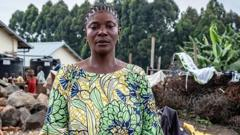
Akilimali Mirindi is one of thousands who have fled the recent upsurge in fighting
US Secretary of State Marco Rubio has said Rwanda’s actions in eastern Democratic Republic of Congo are “a clear violation of” the peace deal brokered by Donald Trump last week.
In a post on X, he said the US would “take action to ensure promises made to the President are kept”, without going into details.
Trump hailed the deal signed with great fanfare in Washington between DR Congo’s President Félix Tshisekedi and Rwanda’s President Paul Kagame as “historic” and “a great day for Africa, great day for the world”.
But the M23 rebel group says it has “fully liberated” the key city of Uvira in an offensive the US and European powers say is backed by Rwanda. UN experts have previously accused it of having “de facto control” of the rebel force’s operations.
Rwanda denies the allegations, however, its presence in Washington was a tacit acknowledgment of its influence over the M23.
The rebels were not signatories to Trump’s deal – and have been taking part in a parallel peace process led by Qatar, a US ally.
The latest fighting risks further escalating an already deeply complex conflict.
Why did the M23 seize Uvira now?
Prof Jason Stearns, a Canada-based political scientist who specialises in the region, told the BBC that the view in M23 circles was that “they need more leverage in the negotiations”, while the feeling in the Rwandan government is that Tshisekedi cannot be trusted.
He added that the assault on Uvira, in South Kivu province, “flies in the face of all the negotiations that are under way”.
“It appears to humiliate the US government. I’m not sure what strategic purpose that would serve,” Prof Stearns told the BBC.
The M23’s new offensive in South Kivu started a few days before Kagame and Tshisekedi flew to Washington last week to ratify the agreement first hammered out in June.
Bram Verelst, a Burundi-based researcher with the Institute for Security Studies (ISS) think-tank, said the assault appeared to be an attempt to force Burundi to withdraw the troops it had in eastern DR Congo backing the army against the rebel forces and Rwanda.
He pointed out that Uvira – which lies just 27km (17 miles) from Burundi’s economic capital, Bujumbura, on the northern tip of Lake Tanganyika – was of strategic importance because of the presence of at least 10,000 Burundian troops in South Kivu.
“Uvira is Burundi’s gateway into eastern DR Congo, to send troops and supplies. That has now been cut off,” Mr Verelst told the BBC.
“It seems that many Burundian troops are withdrawing, but it’s not clear if all contingents will retreat,” he added.
Yale Ford, an Africa Analyst for the Critical Threats Project at the American Enterprise Institute, pointed out that Uvira, which had a population of about 700,000, was the DR Congo government’s last major foothold and military hub in South Kivu.
He added that the M23 was now likely to establish a parallel administration in the city, and use its military gains “as a bargaining chip in peace talks”.
As for the DR Congo government, it has not acknowledged its latest military setback, but says that the “gravity of the situation is compounded by the now proven risk of regional conflagration”.
What does it mean for Burundi?
Burundi has been a natural ally of DR Congo for years because of its enmity with Rwanda.
Both accuse the other of backing rebel groups seeking to overthrow their respective governments.
The neighbours share a
Read More