
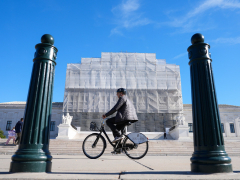

The Supreme Court is likely to hear oral arguments early next year, with a ruling in June on a matter that has been blocked by several lower courts as being unconstitutional.
Published On 5 Dec 2025
The United States Supreme Court has agreed to decide the legality of President Donald Trump’s bid to end birthright citizenship, as the Republican administration continues its broad immigration crackdown.
Following its announcement on Friday, the conservative-dominated court did not set a date for oral arguments in the blockbuster case, but it is likely to be early next year, with a ruling in June.
Recommended Stories
list of 3 items
- list 1 of 3What’s at stake in US Supreme Court birthright citizenship case?
- list 2 of 3Trump vows to push ahead with ending birthright citizenship
- list 3 of 3Can Trump end birthright citizenship? The US Supreme Court could decide
end of list
Several lower courts have blocked as unconstitutional Trump’s attempt to put restrictions on the law that states that anyone born on US soil is automatically an American citizen.
Trump signed an executive order on January 20, his first day in office, decreeing that children born to parents in the US illegally or on temporary visas would not automatically become US citizens.
Lower courts have ruled the order to be a violation of the 14th Amendment, which states: “All persons born or naturalized in the United States, and subject to the jurisdiction thereof, are citizens of the United States and of the State wherein they reside.”
Trump’s executive order was premised on the idea that anyone in the US illegally, or on a visa, was not “subject to the jurisdiction” of the country, and therefore excluded from this category.
The Supreme Court rejected such a narrow definition in a landmark 1898 case.
The Trump administration has also argued that the 14th Amendment, passed in the wake of the Civil War, addresses the rights of former s