
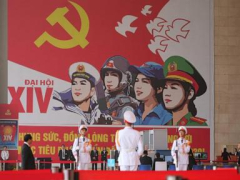

HANOI, Vietnam — Vietnam’s most important political conclave began Monday, as the ruling Communist Party convened to decide the country’s leadership and broad policy course for the next five years.
A total of 1,586 delegates from across Vietnam gathered in the capital, Hanoi, for the National Congress, the party’s highest decision-making body, which meets every five years to elect its top leadership and set priorities shaping the country’s political and economic direction.
Delegates will elect about 200 members to the party’s Central Committee, which in turn appoints 17 to 19 members to the powerful Politburo in a tightly choreographed process.
Beyond settling the question of who will lead Vietnam through 2031, the Congress will also determine how the country’s single-party system responds to far more turbulent world, as the Southeast Asian export powerhouse pursues its ambitious goal of becoming a high-income economy by 2045 amid intensifying U.S.–China rivalry and a splintering global economy.
Here is what to expect.
Communist Party General Secretary To Lam is expected to be confirmed to a full five-year term.
A crucial question is whether he will also move to combine the roles of party chief and state president, as many diplomats and analysts expect. This will concentrate power in an echo of the political model of China under Xi Jinping and neighboring Laos.
Vietnam has traditionally been governed through a “four pillars” system, in which the party chief, president, prime minister and National Assembly chair balance one another. Collapsing those roles would weaken that arrangement and make To Lam the most powerful leader in Vietnam in decades.
He has overseen the most ambitious round of bureaucratic and economic reforms since the late 1980s, when Vietnam liberalized its economy, including cutting tens of thousands of public-sector jobs, redrawing administrative boundaries to speed decision-making, and initiating dozens of major infrastructure projects.
Lam spent decades in the Ministry of Public Security before becoming its minister in 2016. He led the anti-corruption campaign cha