
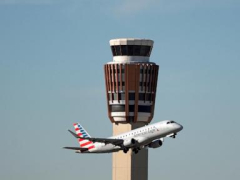

The government picked a company with little experience working with the Federal Aviation Administration called Peraton to oversee the roughly $31.5 billion overhaul of the outdated air traffic control system.
Transportation Secretary Sean Duffy said Thursday evening that Peraton was chosen in the hope that its innovative approach will make it possible to complete the upgrades within the next three years before the end of President Donald Trump’s term in office ends. Peraton was chosen over Parsons Corp., which does have extensive experience with FAA contracts.
“Working together, we are going to build on the incredible progress we’ve already made and deliver a state-of-the-art air traffic control system that the American traveling public — and our hard-working air traffic controllers — deserve,” Duffy said in the announcement.
Here’s what to know about the modernization project and the company hired to oversee it:
Earlier this year, Congress approved $12.5 billion as a down payment on the project after technical problems twice knocked out the radar for air traffic controllers managing planes around Newark Liberty International Airport. This year began with the worst American aviation disaster in years when an airliner collided with an Army helicopter over Washington D.C., killing 67 people.
Duffy has said he’ll need roughly $20 billion more to complete the upgrade.
This effort to upgrade the technology controllers use is on a much more aggressive timeline than the previous NextGen effort that began shortly after the turn of the century and failed to deliver all the benefits it promised even after an investment of $36 billion. The Biden administration had estimated that upgrading the system might take more than a decade.
The FAA hasn’t yet released the details of how much Peraton will be paid for this contract, but the agency said it includes incentives to reward good performance and penalties for shortcomings.
The technical problems that disrupted flights at the Newark airport in the spring demonstrated just how fragile the nation’s aging air traffic control system is. And Duffy has said those kind of technical failures in a system that too often still relies on copper wires and floppy discs could happen anywhere unless the system is upgraded.
Hundreds of flights were canceled or delayed in Newark. After the radar outages, the facility in Philadelphia that controls the flights in and out of Newark had a half dozen controllers go on leave, which forced the reductions in flights.
The number of flights across the country each day that the FAA has to safely manage is expected to continue growing in the years ahead. And drones will continue to proliferate across the country as flying taxis start to take to the air.
Everyone agrees that the air traffic control system must be modernized to be able to handle those future dema