


Lekker Capital CIO Quinn Thompson argues on X that collapsing mining economics, combined with a growing shift by public miners toward AI and high-performance compute, could turn corporate BTC treasuries into a fresh source of market supply.
“A large underappreciated headwind for Bitcoin is the disaster that which is mining economics. The only way this heals is through a decline in hashrate, which is being spearheaded by the AI compute first movers like CORZ, WULF, CIFR, IREN, etc.,” Thompson wrote.
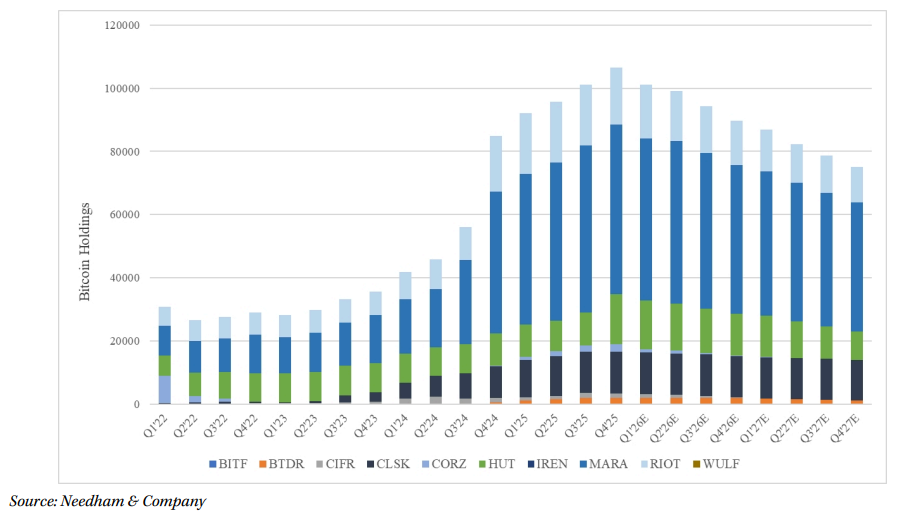
The chart Thompson shared, frames the problem visually. It shows aggregate bitcoin holdings across major listed miners climbing sharply through 2024 and 2025 before rolling over in 2026. Thompson’s argument is not that the AI pivot is bearish in structural terms.
On the contrary, lower hashrate and less uneconomic competition could improve mining industry health over time. His point is that the transition itself is expensive, and that capex-heavy AI buildouts may force miners to liquidate BTC that had previously been treated as strategic treasury.
“While helpful to long-term health and sustainability of the network economics, it presents a dilemma for prices in the near-term as Bitcoin miners hold almost 80,000 Bitcoin on their balance sheets. As these companies pivot away from BTC mining, they 1) need capital to fund the AI buildout capex requirements and 2) have no reason to hold any BTC on their balance sheet (not that they should have before either),” he argued.
Bitcoin Miners Pivot To AI
The 2025 filings and public data make that argument more concrete. Core Scientific’s fourth-quarter results showed the business mix tilting away from mining and toward AI-related infrastructure: self-mining revenue fell to $42.2 million from $79.9 million a year earlier, while colocation revenue rose to $31.3 million from $8.5 million. Management said the decline in hosted mining reflected the “continued strategic shift” to high-density colocation. For full-year 2025, Core generated $402.5 million of proceeds from selling digital assets and ended the year with 2,537 BTC on its balance sheet.
TeraWulf offers an even cleaner read-through. The company said that in 2025 it “solidified HPC hosting as its primary growth engine,” signed more than $12.8 billion in long-term customer contracts, and built a platform with 522 critical IT megawatts under contract. Yet the legacy mini