
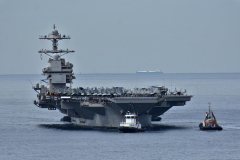


USS Gerald R. Ford is the most-advanced carrier built to date, but it continues to have problems with its sewage system (Photo by Gerard Bottino/SOPA Images/LightRocket via Getty Images)
SOPA Images/LightRocket via Getty Images
The United States Navy’s newest nuclear-powered supercarrier, USS Gerald R. Ford (CVN-78), has been repeatedly described as being the most advanced and capable warship in the world. However, CVN-78 faced numerous delays and cost overruns during construction, and one problem remains unresolved.
The Vacuum, Collection, Holding and Transfer system continues to clog, more than five years after the issue was first identified.
NPR reported this week that the service has grappled with repeated breakdowns with the VCHT, which is similar to systems used on cruise ships.
“It uses less water, but the system used by USS Ford is more complex. Breakdowns have been reported since the $13 billion carrier first deployed in 2023,” NPR explained.
A Problem The Navy Should Have Seen Coming
What makes the issue with CVN-78 noteworthy is that the U.S. Navy had already encountered VCHT problems with the USS George H.W. Bush (CVN-77), the final Nimitz-class nuclear-powered supercarrier. It was the first U.S. Navy warship equipped with the vacuum-based sewage system.
The USS George H. W. Bush seen arriving in the French Mediterranean port of Marseille. Its maiden cruise in 2011 was marred by repeated issues with its sewage system. (Photo by Gerard Bottino/SOPA Images/LightRocket via Getty Images)
SOPA Images/LightRocket via Getty Images
In 2011, all 423 toilets on CVN-77 were simultaneously out of service on two occasions.
According to a report from The Washington Post at the time, sailors had to resort to urinating in showers or into the industrial sinks at their work stations. Some of the male sailors also resorted to using bottles and emptying the contents over the side, while female sailors were holding it for so long that some developed health problems.
Navy officials blamed the issue on sailors flushing “inappropriate material,” including shirts, underwear, socks, feminine hygiene products, eating utensils, and even mop heads.
On at least two occasions during CVN-77’s maiden voyage, all of the heads – the naval term for toilets dating back to the days of sailing ships when the place for the crew to relieve themselves was all the way forward on either side of the bowsprit – were out of service.
Some 10,000 hours were spent in 2011 alone trying to resolve the issues.
A March 2020 Government Accountability Office report, Navy Shipbuilding: Increasing Focus on Sustainment Early in the Acquisition Process Could Save Billions, identified 150 systemic maintenance problems with CVN-78, including the toilets, which it found were undersized for the massive warships.
“The Navy used a brand new toilet and sewage system on the CVN 77 and 78, similar to what is on a commercial aircraft, but increased in scale for a crew of over 4,000 people. To address unexpected and frequent clogging of the system, the Navy has determined that it needs to acid flush the CVN 77 and 78’s sewage system on a regular basis, which is an unplanned maintenance action for the entire service life of the ship.”
Although the acid flush does clean out the system, it costs upwards of $400,000 each time it is performed, and the U.S. Navy still has to determine how often the process is performed.
Clogged Pipes
The VCHT employs vacuum-like suction to pull waste through nearly 250 miles of pipes to treatment tanks, where it can be cleaned and returned to the sea. The system operates in two primary sections, and if one loses vacuum pressure due to a clog, all the toilets on the ship are rendered unusable. In one ship-wide breakdown on CVN-77, it reportedly took 35 hours with no rest to fix. The problem was exacerbated by the lack of a “backup” plan, such as portable toilets or the so-called “wag bags,” which are plastic sacks designed to hold human waste.
C