
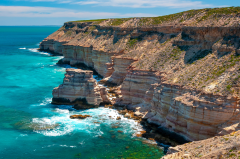

Explore the Indian Ocean coast from Kalbarri to Jurien Bay with wildflowers, beaches, snorkelling, sand dunes, and adventure.
The last of the winter rains are behind me as I drive north of Perth, road-tripping towards Kalbarri, past crumbling sea cliffs and towering sand dunes that shift and drift towards the baby-blue sea. Following the Indian Ocean Drive keeps me close to the sea, winding through rolling golden pastures dotted with wildflowers in sudden, riotous bloom.
The west’s famous flourish of flowers colours the roadside and I pull over to gather an armful of everlasting daisies. These bright pink lollipops decorate my dashboard and frame my driver’s view as I set out to crunch across salt pans and ogle ancient stromatolites, spot sea lions and shipwrecks and stand on the precipitous edge of WA’s highest sand crests.
Sand Surfing
Wangaree, Lancelin’s Yued Indigenous name, simply means “fish”, so I arrive ready to tuck into the town’s famously abundant western rock lobsters — and perhaps some dhufi sh, pink snapper and yellowtail kingfish too. With an entire day of sunshine ahead of me, I decide to paddle up an appetite.
Before the gusty afternoon sea breezes arrive to transform Lancelin into one of Australia’s best kiteboarding and windsurfing destinations, this sparkling bay is calm and I follow the circling seabirds to Lancelin Island Nature Reserve, 700m offshore. A string of rocky outcrops provides sanctuary for the birds and the odd sea lion too, and the extensive reef system that nurtures their ecosystem includes the wrecks of 14 ships and one world-famous dive trail.
Loved by Perth thrill seekers as one of the best boarding destinations in the west, there are waves to surf at Back Beach and 2km-long sand dunes to shred on the northern edge of town. These lure speed demons of all ages and abilities to plunge over the lip riding sandboards, boogie boards, bikes and ATVs. It’s kid-friendly and fun and just a little too irresistible to stand on the sidelines, with thrills and sandy spills in equal doses.
When the sun starts to dip, I take my sandy pants back to the sea, order a feast of fresh and cooked local seafood, and throw down a picnic rug in front of a perfect Indian Ocean sunset.
Plain of Pinncacles
Studding the golden dunes of the Swan Coastal Plain near Cervantes, buried and revealed again by wildly shifting sands, the Pinnacles are a symbol of peace woven into Yued folklore. These stories tell of Wagyl, the rainbow serpent, who weaved his way throughout the region, carving out rivers and landmarks, including these world-famous limestone spires.
Early Dutch explorers mistook them for the ancient ruins of some long-abandoned city — a sea of crumbling columns rising up to 4m in all kinds of strange and phallic guises.
I get to Nambung National Park early, before the tourist crush steals the quiet, and ramble in silence across the plains. Western grey kangaroos emerge to graze from resting places beneath the acacias, and birds fl it in and out of the sun-stretched shadows thrown by dozens of limestone spires.
The Pinnacles Desert Loop Drive weaves through the park, offering pull-offs and parking bays where I leave the car and climb to lookouts and follow short walking trails. I wander until the day-trippers gradually gather and the morning heats up, then drive north.
Underwater Wilds
The Pinnacles might be this coastline’s number-one highlight, but the splendour continues at Jurien Bay, where you can launch your own fishing boat or join a tour to discover offshore islets where distinctly Australian sea lion colonies breed.
Jurien Bay’s 800-strong breeding colony hauls out on three isolated isles — Buller Island, North Fisherman Island and Essex Rocks. Since access to all three spots is restricted, you’ll need to join a tour that might also include scuba diving on underwater pinnacles, whale watching and dolphin spotting.
Around Jurien Bay, extensive seagrass meadows nurture western rock lobsters. A huge variety of sea life thrives, so pack a wetsuit to snorkel the shallows off Boullanger Island. I discover coral bommies closer to shore — right off Jurien Bay’s Town Beach — and an underwater snorkelling trail from the old Jetty that explores a vibrant artificial reef with interpretive signs buried into the sea floor.
When I finally come up for air and dry off , I make a beeline for the opalescent waters of Green Head’s arcing Dynamite Bay. Calmed by great headlands of rugged rock, this near-perfect turquoise cove is a heavenly, white-sand haven with a treasure-hunting history.
Its Yued name, Cuencandjaa, eloquently means “mouthful of sand”, but its more recent moniker comes thanks to a band of 1960s-era treasure hunters who used a Dutch map and a whole lot of dynamite to unearth a bounty of silver treasure from the shipwrecked Vergulde Draeck (Gilt Dragon), sunk off the coast in 1656.
Green Head offers just a handful of laidback places to stay within sight of the sea and magnetises travellers who favour salty, sand-on-your-feet kind of holidays. Staying here also puts me within easy reach of Stockyard Gully’s 250m-long cave adventure.
Spotlighting Stockyard Tunnel
Disappearing underground to escape the midday heat, I follow an ancient seabed that tunnels down into an inky abyss. Occasional but mighty floods wipe out all but the highest, delicate cave decorations, but my torch catches tiny glistening stalactites overhead and reveals rock walls with pale pink and yellow hues.
When I switch off my torch, the darkness is absolute, so the tunnel’s deep crevices and ever-tightening squeezes don’t tempt me off the path. After 15 minutes, a welcoming glow finally looms, and I step out into a lush gully shaded by flooded gums and stunning zamia palms. Vibrant wildflowers colour the undergrowth — orange Christmas trees, Queen of Sheba orchids, yellow leschenaultia and the ubiquitous banksias that feed honeyeaters by day and elusive honey possums by night.
Protected as a reserve, with picnic facilities but no entry fees, Stockyard Gully is strictly 4WD-only, signposted off the Indian Ocean Drive between Leeman and Green Head. It takes only an hour or so to enjoy, leaving time to crunch across the salt-crusted Lake Indoo,n located inland, before setting up a breezy oceanfront camp for the night at the base of Cliff Head.
Shipwrecks, flowers and lolly-pink lakes
The Indian Ocean Drive officially ends where it meets the busy Brand Highway, but another swathe of blue bays and laidback hamlets beckons me north, past Greenough Flat’s great leaning trees sculpted by the unrelenting winds, to Geraldton for some seafaring history.
European explorers, sailing too close to the west coast in the 1600s, littered the sea floor with their treasure-filled shipwrecks. Their terrifying tales of survival, mutiny