
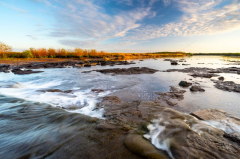

The Northern Territory is a land of extremes — a place where wetlands stretch further than the eye can see and sunsets paint the sky in colours too vivid to capture on camera. Just a few hours east of Darwin lies the Mary River, a wild sanctuary where barramundi leap against the tide, sea eagles hunt overhead and campers fall asleep to the chorus of frogs.
Darwin has its heart-stopping “jumping croc” river cruises, but nothing excites me more than the idea of sleeping under the stars in a place more densely populated by estuarine crocodiles than anywhere else on earth.
Just 150km from Darwin’s five-star waterfront comforts, the prodigious Mary River covets a landscape of mind-boggling size and beauty: lily-fringed lagoons and vast, verdant floodplains, dense monsoon forests and mangrove-fringed tidal reaches that lure big crocs in from the Arafura Sea.
Safeguarded as a national park, the Mary River Wetlands gathers a fan club of anglers, walkers and wildlife watchers, but this sanctuary – I quickly discover – is a primitive place to dwell.
Our family sets up a rustic home base at Shady Camp, stacking firewood and shaking out camp chairs, then heads for the nearby riverbank to enjoy the cool hours before sunset when wildlife emerges to feed. In the late 1980s, a barrage was constructed across the Mary River in an attempt to keep saltwater flow out of the wetland’s precious, but threatened, freshwater habitat upstream.
What this skinny concrete dam fails to do is stop estuarine crocodiles and other determined amphibians from moving up and downriver as they please. So, it’s an incongruous sort of place to find a lineup of anglers standing ankle-deep on the barrage, casting their lines.
Battling barramundi
After the Top End’s long wet season, the run-off begins, draining rivers and wetlands and rushing all that water swiftly back to the sea. The Mary River Wetlands purge their sodden marshes too, gathering up hapless fish in the rapid flow and sending them plunging over the barrage.
Anticipating the frenzy, anglers arrive to pick them off en route, stealing prized catches of barramundi from the salties circling below, their great tails raised, swinging slowly back and forth.
The vigorous rush of water makes this a treacherous place to cast a line, but the punter plonked in his camp chair midstream appears utterly undeterred. I skip nervously past them towards higher ground on the opposite bank and, watching the crocs, try to decide if these apex predators below are waiting for fish or a heftier, human-sized meal.
While all this barramundi chasing is taking place, an astonishing thing happens. Powerful mullet begin to leap upstream, doggedly scaling the barrage against the rushing tide. There are dozens of them – small but determined – and they slowly make ground, forcing their way over the concrete barrier into the freshwater pool above.
A sea eagle suddenly swoops down and snares a fish with its mighty talons, devouring it mere metres away in the low branches of a riverside tree. Cormorants are fishing too, and when the anglers lose interest and move on, a trio of juvenile nankeen night herons descends to fish silently as the sun retreats.
Sunset in the wetlands
Upstream and close by Shady Camp, a short riverside trail flanks the freshwater lagoon, leading us to a viewing shelter where we sit and watch the birds. We spot Jesus birds – light-footed jacanas – that leapfrog effortlessly across the pink lotus lilies, earning their moniker by appearing to walk on water.
Great flocks of magpie geese circle languidly overhead, whistling ducks fly straight on to some faraway roost, and a solitary jabiru forages silently in the shallows. This auditorium is alive with wild sights and sounds: raucous cockatoos noisily stripping the riverside pandanus, rainbow bee-eaters hunting on the wing and frogs croaking from their hiding places on the muddy banks.
Agile wallabies nibble nervously on the grassy verge, while freshwater crocodiles float on the fringes, waiting patiently for their chance to move in. We linger too long and meet the mangrove’s most veracious inhabitant – mosquitoes that descend in a thick, buzzing cloud and send us swatting and slapping on a mad dash back to camp.
When repellent and a smoky campfire fails to dampen the mosquitoes’ appetite, we concede defeat and head to our beds, falling asleep to the drone of them clinging to the mossie-proof screens.
Celebrating Stuart
Sunrise scatters the mossies and our serenity is restored, so we dawdle over our morning coffees before the day’s exploring begins. We take a long walk around Shady Camp, named by pioneering explorer John McDouall Stuart in 1862 after he rested on the banks of the Mary River near the end of his epic, cross-country expedition.
Stuart had pioneered a 3540km-long route from Port Augusta to the then-called Port Darwin that finally opened up Australia’s mysterious interior. After a night spent at Shady Camp, he ended his long journey by reaching the sea, at the site that now immortalises his tremendous feat.
Following in Stuart’s footsteps is, ironically, very much dependent upon the weather. Only when the road dries out enough to allow 4WDs to make the trip can you reach Point Stuart and take a walk. If you get the chance, tackle the rigorous, scenic trail that loops along the bay to Stuart’s Tree Memorial Cairn (6km, three hours return).
With the track still sodden and the gate firmly shut, we take our walking shoes to Point Stuart Wilderness Lodge instead, and set out along the Jimmy Creek Monsoon Forest Walk (1.6km, 30 minutes).
Forest wandering
Cool and shady, this easy track disappears quickly into the forest, crossing crystal-clear streams and winding past verdant palms and giant banyan trees draped with prickly vines. Ferns carpet the forest floor where active orange-footed scrub fowls are busy scraping together their big nesting mounds.
There are mossies hiding from the heat of the day too, but our repellent keeps them at bay and before we know it, this love