
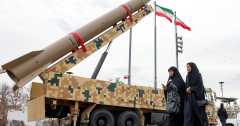

With President Trump’s threat to attack Iran looming over the discussions, American and Iranian negotiators sat down again in Switzerland Thursday, separately, for another round of talks brokered by Oman, focusing on the Islamic Republic’s nuclear program.
Iran says it does not have and will not build a nuclear weapon, and Mr. Trump has said he will not allow Tehran to acquire one — a position he shares with his recent predecessors Barack Obama and Joe Biden.
The Obama administration spent months negotiating an international deal to constrain and monitor Iran’s nuclear enrichment program. But during his first term, Mr. Trump attacked the pact as “horrible” and pulled the U.S. out. Since returning to the White House, Mr. Trump has threatened to strike Iran if it doesn’t make a new deal to curb its nuclear activities.
Despite warnings from many nations in the Middle East and elsewhere, including Iran, that any U.S. strike could spark a major international conflict, Mr. Trump has ordered the biggest American military buildup in the Middle East in decades, pressuring Tehran to make the deal he wants.
A photo shared by the Omani Foreign Ministry shows Foreign Minister Badr bin Hamad Al Busaidi (left) meeting with U.S. special envoys Steve Witkoff, center, and Jared Kushner for Omani-brokered talks on Iran’s nuclear program, in Geneva, Switzerland, Feb. 26, 2026. Ministry of Foreign Affairs of Oman/Handout 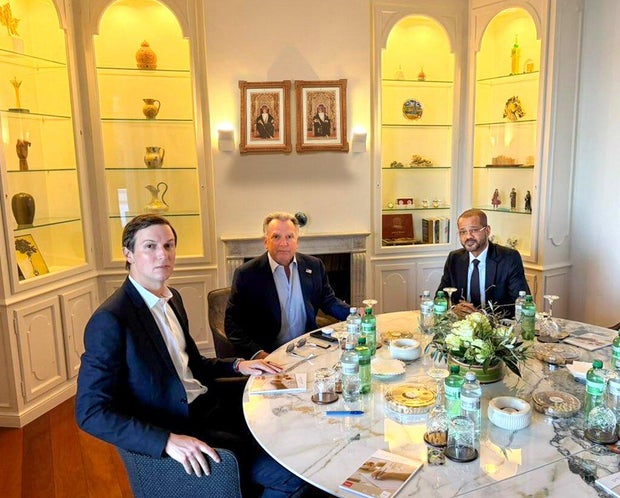
Mr. Trump has given no indication about whether he’s decided to use force as the talks continue, so CBS News asked people with deep knowledge of Iran and the country’s hardline Islamic rulers to try to gauge the prospects of an agreement emerging from the talks to avert a war.
What Iran and the Trump administration have said
During his State of the Union address on Tuesday, Mr. Trump repeated his claim that the U.S. “obliterated Iran’s nuclear weapons program” with strikes in June — a claim the U.N.’s nuclear watchdog agency, the IAEA, has recently cast doubt on — and said despite his warnings, “they’re starting it all over. We wiped it out and they want to start it all over again and are at this moment again pursuing their sinister ambitions.”
The president has said repeatedly he prefers a diplomatic solution to the standoff but that he is prepared to use the U.S. military if he deems it necessary.
Mr. Trump claimed in his Tuesday remarks that Iran had never ruled out building a nuclear weapon, but the country’s foreign minister, Abbas Araghchi, vowed not long before the U.S. leader spoke that Iran would “under no circumstances ever develop a nuclear weapon.”
“We have a historic opportunity to strike an unprecedented agreement that addresses mutual concerns and achieves mutual interests,” Araghchi said in a social media post, adding that a deal was “within reach, but only if diplomacy is given priority.”
A photo shared by the Foreign Ministry of Oman shows Foreign Minister Badr bin Hamad bin Hamoud Al Busaidi, right, during a meeting with his Iranian counterpart Abbas Araghchi, Feb. 25, 2026, in Geneva, Switzerland, as part of ongoing negotiations between the U.S. and Iran over the Islamic Republic’s nuclear program. Ministry of Foreign Affairs of Oman/Handout 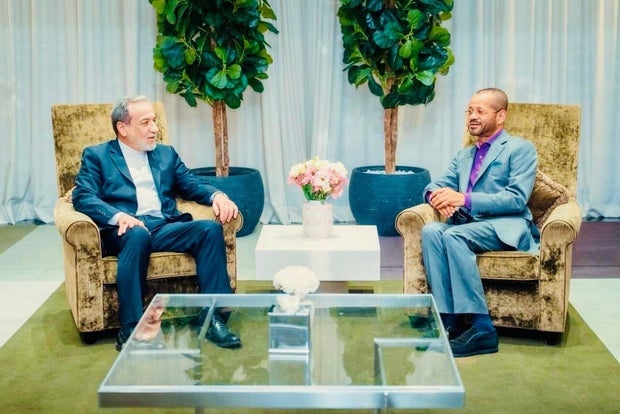
Araghchi insisted, however, on Iran’s right to “harness dividends of peaceful nuclear technology” — hinting at one of the major sticking points the negotiators in Geneva will need to work on.
While he didn’t reiterate the demand — pushed hard by Israel — in his State of the Union address, Mr. Trump has previously said any new nuclear agreement with Iran should include a full abandonment of all domestic uranium enrichment. That is something Tehran has said it cannot accept.
“Enrichment is our right,” Araghchi reiterated Sunday on CBS’ “Face the Nation with Margaret Brennan,” noting that Iran is “a member of NPT [nuclear non-proliferation treaty] and we have every right to enjoy a peaceful nuclear energy, including enrichment.”
Araghchi said he couldn’t predict whether President Trump intends to strike his country, but he told Brennan, “I believe that still there is a good chance to have a diplomatic solution, which is based on a win-win game,” calling a solution to the standoff “at our reach.”
“War looks inevitable,” says one Iran expert
Despite this public expression of optimism from Iran’s side, Sanam Vakil, director of the Middle East and North Africa Program at the Chatham House thinktank in London, believes the two sides are still too far apart. She told CBS News on Wednesday that, in her view, a military clash is inevitable, and soon.
“I think it’s imminent — I mean it’s a matter of days. War looks inevitable to me because President Trump has been not just assembling a huge arsenal to strike Iran, but also because President Trump has been clearly signaling that he is seeking the submission of the Islamic Republic to terms and conditions that currently the leaders in Iran don’t appea