

This is a rush transcript. Copy may not be in its final form.
AMY GOODMAN: This is Democracy Now!, democracynow.org. I’m Amy Goodman.
We’re continuing our look at the life and legacy of the Reverend Jesse Jackson, who died today at the age of 84, a civil rights icon, two-time presidential candidate.
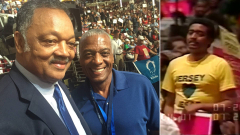
We’re joined now by two guests. Larry Hamm is a longtime civil rights activist. He’s chair of the People’s Organization for Progress. He was co-chair of the Jackson for President campaign in New Jersey in 1988, also a Jackson delegate at the Democratic National Convention then and the former resident of — president of the New Jersey chapter of the Rainbow Coalition. And we’re joined by Clarence Lusane, political science professor at Howard University, the director of the International Affairs Program there.
We welcome you both to Democracy Now! Professor Clarence Lusane, let’s begin with you. You woke up this morning with this news of this historic figure having passed, the Reverend Jesse Jackson. Your thoughts on his significance, on his life and legacy?
CLARENCE LUSANE: Good morning, Amy. Good morning, Larry, as well.
Yeah, my phone has been blowing up with texts from not just people here in the U.S., but from around the world, as the news spread.
I want to echo what Bernie Sanders said about Jackson’s contribution. Jackson’s life contributed to making this country more democratic, more inclusive, more fair. What Jackson was able to do was to marry movements, grassroots movements, with electoral politics. Prior to the 1980s, a lot of activists who were working on issues, from anti-nuclear kinds of concerns to peace issues to civil rights, had a kind of sketchy relationship with electoral politics. And Jackson saw that that was a vehicle for being able to bring this country to its principles that it espouses.
And so, in ’84 and in ’88, Jackson was doing two things. One was building an electoral movement that would make the Democratic Party and electoral politics more democratic, but at the same time, he was also building a movement outside of that, the National Rainbow Coalition, which picked up the mantle from the civil rights movement and from what Dr. King and others had been doing in the 1960s and brought that into the 1980s and beyond. And his contributions were not just domestic, of course, but also international, not only working with folks who were working around issues like human rights and peace, but just a range of concerns that people had around the world, including, of course, the anti-apartheid movement.
AMY GOODMAN: And talk about that, especially for young people who aren’t so familiar with the movement to take down apartheid in South Africa, and going back to 1966, the March Against Fear in Mississippi, oh, up through — what was it? — 2000 with the fight around Gore and Bush.
CLARENCE LUSANE: Yeah, the 1966 March Against Fear happened in Mississippi. This was three years after King had given his speech at the March on Washington, “I Have a Dream” speech. And Medgar Evers had been killed. And James Meredith, who was a local activist in Mississippi, started a march. He was shot during that march, but that then galvanized the entire civil rights movement to come to Mississippi. So, Jackson was there, King was there, Stokely Carmichael was there. That’s where Stokely Carmichael made his famous statement about Black Power. And that’s important, because what we see with Jackson is that he brought together the disparate parts of not only the Black political movement, people who were nationalists, people who considered themselves socialists, people who considered themselves liberals, even Black conservatives, Jackson would galvanize and rally, and when he ran in ’88 and ’84, but Jackson also brought together people outside of the civil rights community and outside of the Black community. And so, that was really kind of a turning point.
So, then we get into 1983, and there’s a big celebration of the 20th anniversary of the March on Washington, but it’s also protests against Reagan. Reagan had been elected in 1980 and launched the harshest anti-civil rights presidency to that date. And so Jackson and civil rights leaders and trade unions and others called for this march. And at that March, there was a grassroot — there had been a grassroots movement growing, and it swelled: “Run Jesse Run!” So, this wasn’t Jackson just saying, “I want to be president.” This was a recognition of Jackson’s work, his moral and political clarity in that moment. And he launched not only his presidential campaign, which many of us worked on, and Larry was critical in that, Ron Daniels, Jack O’Dell, others, but he also launched the National Rainbow Coalition, and they worked in parallel.
And as Bernie said and others have noted, the reason Barack Obama becomes president in 2008 is because of the work that Jackson and others, like Fannie Lou Hamer, who made sure that the Democratic Party would democratize and change the rules of the game, so that when Obama ran in 2008, he was running under very different circumstances than even when Jackson ran in 1984 and 1988.
And Jackson continued that inside-outside strategy pretty much all of his life. He was active around the Gore v. Bush controversy, for example, where in 2000, when Gore ran against Bush, and essentially Florida stole the election, there was a suit, and Clarence Thomas and others on the Supreme Court basically gave the election to — the Electoral College to George W. Bush. Jackson was one of the people out in the street who was organizing and mobilizing around that movement. So, he never kind of gave up at any point along the way.
And again, just really quickly, on the anti-apartheid movement, for decades, the South African white minority held the Black majority under severe segregation. And there had been a global movement to bring down that government. Jackson was a central voice in this country consistently on raising that issue. And then, when finally Mandela was released from prison, Nelson Mandela, who was the leader of the African National Congress, Jackson was there. And after Mandela became president, Jackson continued to support a new South Africa and a more democratic South Africa. So, it’s really important, as you note, that this is taught. And at Howard University, we certainly include Jackson in our courses on Black politics and in other