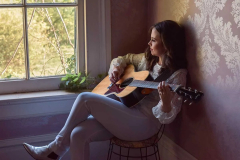
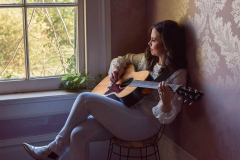

Sierra Hull seems to be everywhere on the Americana/roots music scene these days—leading her own band as mandolinist, singer, and songwriter; picking bluegrass with Béla Fleck and Sturgill Simpson; playing duets with Billy Strings, Molly Tuttle, Tommy Emmanuel, or her husband, Justin Moses; writing and performing with funk/jazz guitarist Cory Wong; and sitting in with bands of all stripes. In every setting, Hull exudes both mastery and joy on her instrument, thriving on the energy of collaboration.
Somehow in the midst of all this activity, Hull, who turns 34 this fall, continues to forge ahead as a songwriter and bandleader, taking a big step forward with her latest release, A Tip Toe High Wire. As ever, her music sits on a foundation of traditional bluegrass, but with the addition of drums and a wide-open rhythmic sensibility, her latest songs range from funky acoustic pop (“Boom”) to blazing instrumental fusion (“E Tune,” with Fleck) to luminous folk balladry (“Spitfire”).
A six-time winner for mandolinist of the year at the International Bluegrass Music Awards, Hull is best known for her astonishingly fluid mandolin work—she began turning heads on the instrument as a kid growing up in small-town Tennessee and made her debut on the Grand Ole Opry at age ten. But guitar has also been part of her musical world since childhood and is a significant presence on A Tip Toe High Wire. As Hull shares in this conversation, on a video call from her home in Nashville, mandolin and guitar work together to power her songwriting and creativity.
You started very young on the mandolin, but when did guitar first come into your life?
Pretty early, actually. I started playing mandolin when I was eight. I got a fiddle for Christmas to begin with. It was full size, so it was just too big. My dad was like, “We’ll get you a smaller one—trade it in or something. In the meantime, the mandolin is tuned like the fiddle, so we can give you a little bit of a mandolin lesson. You’ll know at least where to put your fingers.”
I don’t know if it was because mandolin was the first instrument that I actually got to make music on, but that became my main instrument. My dad was already playing guitar a little bit at that time, and I have an older brother who plays as well. So I felt like I was around the acoustic guitar as much as anything, just watching someone play. The mechanics I was learning with the mandolin were also so similar, as far as the flatpicking guitar stuff goes—pick hold, pick strokes, placement of fingers on the frets, all that kind of dexterity stuff. It felt like a really natural progression to pick up the guitar. The guitar came quickly as a result of having a year of playing mandolin under my belt, and recognizing what a C chord and a G and D looked like. I had a bit of an advantage just from that.
In the bluegrass world, it’s common for people to pick up multiple instruments—guitar, banjo, mandolin, fiddle. Do you think that’s built into the background?
Maybe so. Musicians have such a community within the bluegrass world. There’s a sense of sharing what you know. Everybody’s always so willing to be like, “Oh, cool—you want to learn to play the banjo? I’ll show you a little something.” That sharing culture is so ingrained that it feels like a safe space to explore other things without somebody being like, “Oh, no—stay in your lane, kid.”
Bluegrass is also all about playing with other people. In many other genres, people learn more in isolation.
Absolutely. I mean, my husband is a multi-instrumentalist, one of the best that I know. He’s on a different unicorn scale, where he’s so proficient on mandolin, guitar, banjo, dobro, fiddle. I’ve mostly stuck to mandolin and guitar. You really wouldn’t want to hear me play fiddle. I did play a little bit of fiddle as a kid, just because grannies loved it on both sides of my family and, you know, people back around Tennessee love some good fiddle playing.
Has guitar become more connected with songwriting for you?
A little bit. I’ve started using mandolin or octave mandolin more and more over the years to write, but guitar is kind of the ultimate instrument to write on. Some people say piano is that, but I don’t play any piano. There’s something so familiar with the sound of the guitar. It’s in every style of music. You don’t play something on the guitar and automatically feel locked in one place or genre, and that’s the beauty of it. So naturally, it ends up being a tool that I use a lot for writing.
You play a good amount of guitar on A Tip Toe High Wire. Is there a particular reason?
Sometimes, if guitar is the tool I’m writing with, the main hooks of the songs become ingrained. With the song “Boom,” for example, that opening riff and groove was something I had been playing around with on the guitar and then adapted to mandolin. If you come see us play this song live, Shaun Richardson, who’s an incredible guitarist that I get to travel with, plays the acoustic parts, but he played electric on the recording. It felt natural for me to play the [acoustic guitar] part in the studio, because that is the way it was written.

The same thing with “Spitfire,” which is very much built around the lyric as a storytelling song. Sometimes, as the singer, there’s a connection you have to guitar as the main support and driver of a song that’s different than what the mandolin can do. Mandolin can have that role on certain songs—like on this record, “Let’s Go” was totally written on mandolin. But on something like “Spitfire,” “Redbird,” or “Truth Be Told,” I’m playing one of the guitars, and also went back and added mandolin.
When you switch between mandolin and guitar, does the difference in how the instruments are tuned require some kind of reset?
I probably should feel that way. But I think just because I started so young, coming from the bluegrass world, I really didn’t think about tuning as much as feel and even the muscle memory and patterns.
So much of my early playing was built around spending time with the instrument, learning from other people, learning fiddle tunes. Tony Rice was one of my biggest heroes—not just for guitar, but his records and the songs that he chose to sing. Being such a fan, I was sitting down and trying to learn my fair share of Tony Rice solos, and Doc Watson, all that kind of stuff. I loved guitar. And there is such a natural connection from, like I said, the right- and left-hand technique, I didn’t have to think about, I’m going to mandolin and I’m back to fifths. My brain at the time wouldn’t have even really known that’s what was going on. I didn’t learn to play music in a real technical way where I would have had the vocabulary for that.
As a guitarist, I’ve always felt that the symmetry of mandolin or fiddle tuning would allow a different kind of freedom in playing solos and melodies compared with guitar, just because of the rogue interval on guitar between the third and second string. Does that make sense to you?
It does. I hear a lot of people talk about that. On mandolin the tunings are parallel all the way through. You’re looking at a mirrored kind of thing from string to string. Plus, on mandolin I can jump an octave or three octaves in some cases pretty quickly. We have so much less real estate on the mandolin.
So yeah, on guitar, you don’t have that as much, but, man, there’s also so much more you can get at, because you just have a wider scope. You can play ful