

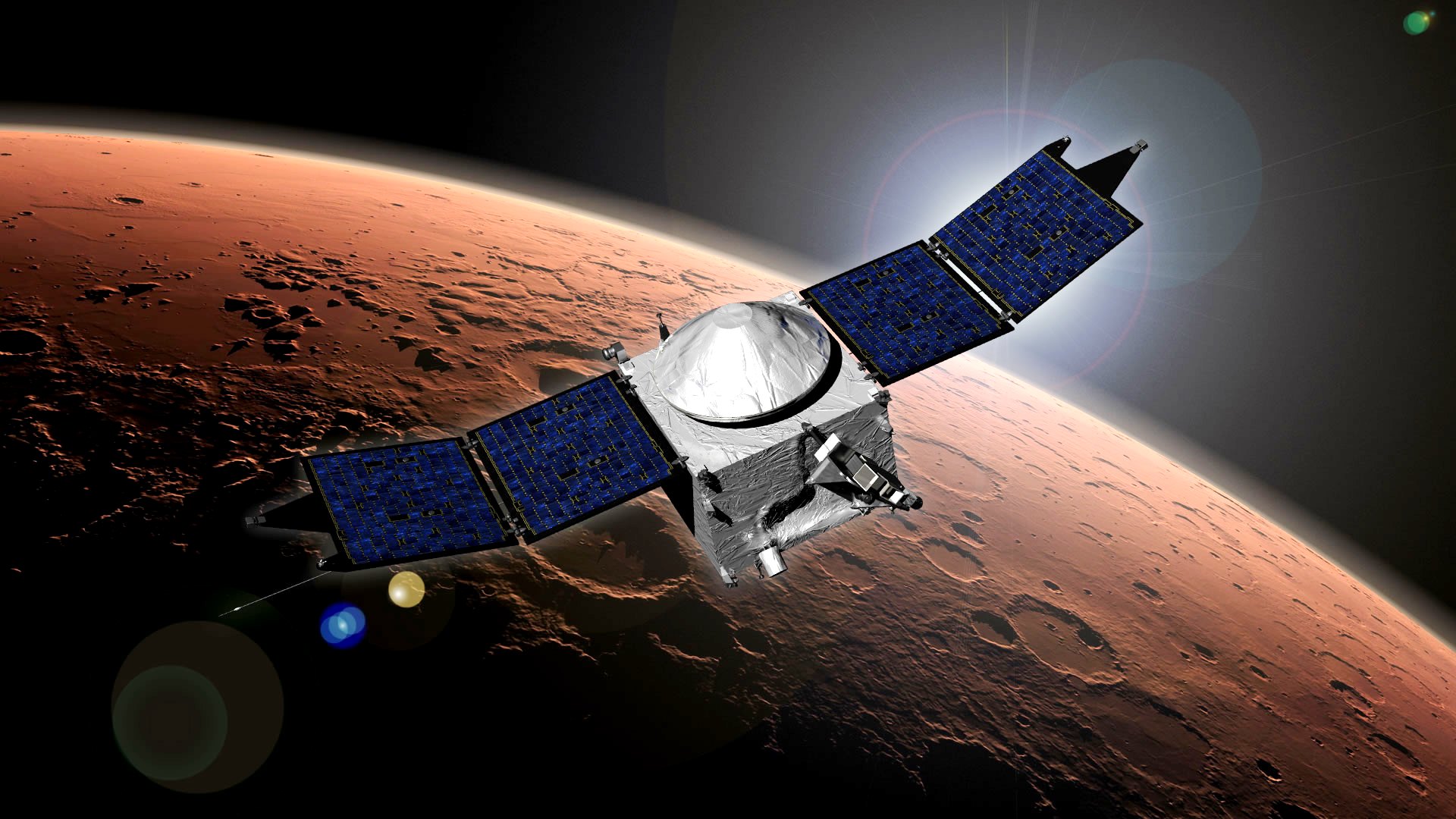
(Image credit: NASA GSFC)
Things aren’t looking good for one of NASA’s Mars orbiters.
MAVEN (short for “Mars Atmosphere and Volatile Evolution”) has been silent since Dec. 4, despite repeated efforts to hail the spacecraft, NASA announced in an update on Monday (Dec. 15). And a fragment of tracking data recovered on Dec. 6 delivered a bit of additional bad news.
MAVEN launched in November 2013 and arrived in Mars orbit 10 months later, tasked with studying Mars’ atmosphere and how it interacts with the solar wind, the stream of charged particles flowing from the sun.
MAVEN’s prime mission lasted one Earth year, and the spacecraft delivered in that time. Its data helped scientists understand how (and when) the Red Planet lost its once-thick atmosphere, which allowed liquid water to flow on Mars billions of years ago.
The orbiter just kept going after that, gathering loads of information about the Red Planet — for example, its dust storms, winds and auroras, for example.
MAVEN also serves as a communications link between mission control and NASA robots on the Martian surface — at the moment, the Curiosity and Perseverance rovers.
But MAVEN isn’t the only orbiter that plays this relay role; NASA’s Mars Reconnaissance Orbiter and Mars Odyssey do as well, along with the European Space Agency‘s Mars Express probe and ExoMars Trace Gas Orbiter. And those four other spacecraft are still going strong.
“For the next two weeks of scheduled surface operations, NASA is arranging additional passes from the remaining orbiters, and the Perseverance and Curiosity teams have adjusted their daily planning activities to continue their science missions,” NASA officials wrote in the update.