
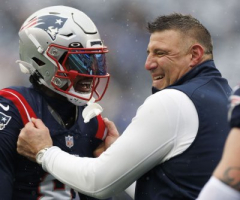

1 of 5 | New England Patriots head coach Mike Vrabel (R) said he prioritized improving his communication skills in recent years. File Photo by CJ Gunther/UPI | License Photo
SAN FRANCISCO, Feb. 6 (UPI) — Mike Macdonald does not care — about preseason expectations, perceptions about his coaching style or even about his players likening him to an AI robot cosplaying as a human.
After all, the coach’s admittedly militaristic approach has his Seattle Seahawks in Sunday’s Super Bowl.
On the other Levi’s Stadium sideline will stand a man with the same first name, who oozes authenticity and passion, while constantly finding ways to express love and forge connectivity with his players.
The contrasting styles bred nearly identical results for Mike Vrabel’s New England Patriots (17-3) and Macdonald’s Seahawks (16-3), who will meet in what the former deemed an “identity war” in Super Bowl LX in Santa Clara, Calif.
“You’re not waking up in the morning trying to be a players’ coach or not be a players’ coach or I want to be this type of coach,” Macdonald said.
“We have a vision about where we want to go. And we’ve all decided we want to go there. And if the intent of our team is right, we’re right alongside you. I want you to go rip it in practice. I want you to go prepare your tail off, but then go play.”
Macdonald, who ditched a lucrative finance career to become a football coach, grew up listening to military stories from his father Hugh, a West Point graduate and Army veteran. It’s no accident the lessons learned in those tales seeped into the Seahawks’ facility.
He often philosophizes about “commander’s intent,” cited by the Marines as a concise statement detailing the end state of a battlefield, which can include a purpose of operations, enemy actions or intentions and identification of the enemy’s critical vulnerability.
He also has brought his players into contact with Army Green Berets and Navy SEALs at the Seahawks’ facility and at their bases.
“I have a ton of respect for my dad, but a lot of my family are also military members and served in wars,” Macdonald said. “So you’re exposed to it your whole life, and as you learn more about it, I mean, those are the people that are protecting our freedom on a daily basis, put it on the line for us. And they also happen to be some of the best operating teams in the world.
“Why wouldn’t you want your team to embody a lot of those principles?”
The second-year head coach influenced players to follow mantras of “MOB” or “mission over bull [expletive],” as well as “chasing edges.” A wall in their facility reads “a style nobody wants to play.”
It’s easy to see why players are now bought in, as they don Super Bowl patches on their jerseys. But the investment started in the daunting days of training camp, with players facing grueling conditioning tests, including six 150-yard shuttles, with a time limit depending on their position. If they failed to complete any of those legs in their allotted time, they were forced to start over.
Militaristic blueprint
Some players playfully embraced the tactics by saying “hooah” in response to the coach, another nod to the militaristic blueprint.
Macdonald says the buy-in wasn’t immediate for the Seahawks, who were coached by Pete Carroll — known as a players’ coach — for 14 years before his arrival. They began with an initial goal to be “tough and connected.” Now, if you turn on the tape, it’s immediately evident that the swarming and gang tackling Seahawks are elite in harmonic harassment.
Macdonald was the architect of a unit that led the NFL in crucial advanced metrics, including defense adjusted value over average, or DVOA. The Seahawks also were great by conventional statistical standards, allowing the fewest points and second-fewest yards per play in the NFL.
“Is it a moment where you snap your fingers? No,” Macdonald said. “I think it’s the buy-in at the beginning of the process. It’s the daily inputs that the guys did. And then I think over time, you feel the belief in the team.”
“You feel what happens in our execution and training camp. You felt the team throughout the season, in the preseason games and it’s one of those things where you just have to keep chasing it every day.
“The guys [who] believed in it deserve a lot of credit for having faith in their teammates, and it’s a thing that just you know it really does take every day all the way up until today. You know it’s going to take all the way all through Sunday, as well.”
Like many championship-driven rosters, Seahawks players mimic many of their coaches beliefs and echo his words. Linebacker Ernest Jones IV called Macdonald a “maniac behind the scenes” who can act “a little crazy” when players aren’t perfect in practice.
“I say this all the time. We work harder than any team in the league because it’s a strict regiment and he never lets up on us,” Jones said. “When times got hard, he preached and he kept us going. I owe a lot of our success today to Mike, and the way that he just kept us into it, regardless of the situation.”
Defensive tackles Jarran Reed and Leonard Williams said Macdonald demanding greatness and discipline from himself leads to a desire for his players to want the same from each other. But despite the somewhat robotic facade, Seahawks players still feel a familial touch from the coach.
“We joke around and say that he’s pretty much like an AI [bot] and that he’s learning how to be human,” Williams said. “It’s just an inside joke, though. But, I think he’s just a really smart guy. He’s just all about football. I mean, the way he treats us in the building is like his family.”
Coaches’ influence
Macdonald cites the many coaches who influenced him during