
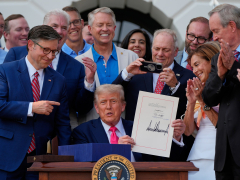

‘One Big Beautiful Bill Act’, higher tariffs and immigration crackdown are factored into the report.
Published On 11 Feb 2026
The nonpartisan Congressional Budget Office’s 10-year outlook projects worsening long-term United States federal deficits and rising debt, driven largely by increased spending, notably on Social Security, Medicare, and debt service payments.
Compared with the CBO’s analysis this time last year, the fiscal outlook, which was released on Wednesday, has deteriorated modestly.
Recommended Stories
list of 4 items
- list 1 of 4Top Canadian pension fund halts deals with UAE firm over Epstein ties
- list 2 of 4Bulgaria’s president picks senior central bank official as acting PM
- list 3 of 4US reopens airspace over El Paso after claim of cartel drone infiltration
- list 4 of 4Libya issues rare oil exploration licences to foreign firms
end of list
The CBO said that the deficit for fiscal 2026 – President Donald Trump’s first full fiscal year in office – will be about 5.8 percent of GDP, about where it was in fiscal 2025, when the deficit was $1.775 trillion.
But the US deficit-to-GDP ratio will average 6.1 percent over the next decade, reaching 6.7 percent in fiscal 2036 – far above US Treasury Secretary Scott Bessent’s goal to shrink it to about 3 percent of economic output.
Major developments over the last year are factored into the latest report, including Republicans’ tax and spending measure known as the “One Big Beautiful Bill Act,” higher tariffs, and the Trump administration’s crackdown on immigration, which includes deporting millions of immigrants from the US mainland.
As a result of these changes, the projected 2026 deficit is about $100bn higher, and total deficits from 2026 to 2035 are $1.4 trillion larger, while debt held by the public is projected to rise from 101 percent of GDP to 120 percent — exceeding historical highs.
Notably, the CBO says higher tariffs partially offset some of those increases by raising federal revenue by $3 trillion, but that also comes with higher inflation from 2026 to 2029.
Rising debt and debt service are important because repaying investors for borrowed money crowds out government spending on basic needs such as roads, infrastructure and education, which enable investments in future economic growth.
CBO projections also i